
You had an X-ray for heel pain, and the report says "calcaneal spur." It is natural to picture a sharp piece of bone digging into your foot with every step. In most cases that is not what is happening. A heel spur and plantar fasciitis often show up together, but they are not the same thing, and the spur is usually not the source of the pain. Here is how the two differ and what that means for treatment.
What a heel spur is
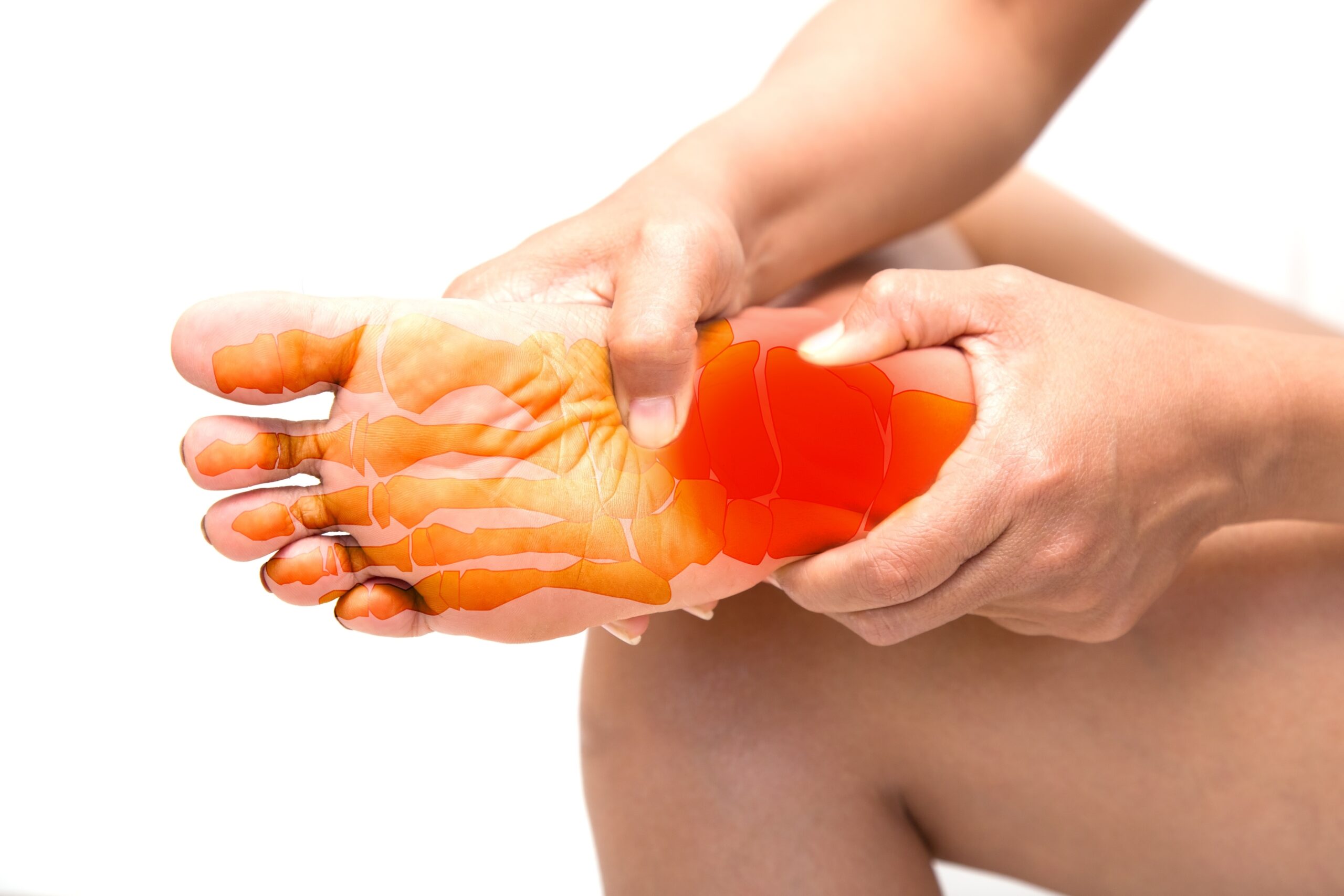
A heel spur is a small bony outgrowth on the underside of the heel bone (the calcaneus), near where the plantar fascia attaches. It can be seen on a side-view X-ray. The American Academy of Orthopaedic Surgeons (AAOS) explains that a spur can form after long-standing tension where the plantar fascia attaches to the bone.
Researchers still debate exactly why spurs form. A 2017 anatomy review found that most spurs do not sit inside the plantar fascia at all. They lie deeper, above it. A study of X-rays from 216 older adults found spurs were linked to higher body weight, and the authors suggested spurs may be the bone's response to repeated downward pressure on the heel, not to the fascia pulling on it.
Spurs also tend to point forward, along the foot, not straight down into the ground. That is one reason they are less of a "thorn" than they look on film.
What plantar fasciitis is
Plantar fasciitis is irritation and breakdown of the plantar fascia, the strong band of tissue that runs from your heel to your toes and supports the arch. The classic signs are pain under the heel with your first steps in the morning or after sitting, and pain that is worse after activity than during it. It is a soft-tissue problem. It does not show on an X-ray. For more on the condition itself, see what is plantar fasciitis.
How common are heel spurs, with and without pain?
Spurs are common, including in people whose heels feel fine.
| Who was studied | How many had a heel spur |
|---|---|
| Young to middle-aged adults in general (2017 review) | 11% to 21% |
| 216 adults aged 62 to 94 (2008 X-ray study) | 55% |
| People with plantar fasciitis (2017 review) | 45% to 85% |
| People with no heel symptoms, used as comparison groups (2017 review) | 10% to 63% |
| 19 people with plantar fasciitis vs. 19 matched people without it (2012 study) | 89% vs. 32% |
Two things stand out. Spurs are clearly more common in people with plantar fasciitis. And a large share of people with spurs have no pain. Spurs also become more common with age. In a study of 1,080 ankle X-rays, no large spurs under the heel were seen in anyone younger than 40.
Does the spur cause the pain?
Usually not. The AAOS states it plainly: most people who have bone spurs on their heels do not have heel pain, and heel spurs do not cause plantar fasciitis pain.
The research supports a link but not a simple cause. The 2012 study that found spurs in 89% of plantar fasciitis patients concluded there is a significant association and said more research was needed to learn whether one causes the other. The likeliest explanation is that the same forces, such as years of load on the heel, extra body weight and a tight calf, contribute to both.
There is one nuance worth knowing. In an MRI study comparing 100 people who had wasting of a small foot muscle with 100 who did not, heel spurs were more common in the first group (48% vs. 7%). That muscle is supplied by a small nerve under the heel called Baxter's nerve, so the finding suggests a spur may sometimes play a part in nerve irritation. This is a different problem from plantar fasciitis, with burning or tingling as clues. Our guide to conditions mistaken for plantar fasciitis covers it.
Questions about your treatment options? Dr. Fox can help.
Book a ConsultationThis article is part of our Heel Pain Guide.
How each is diagnosed
Plantar fasciitis is diagnosed mainly from your story and an exam. Your doctor presses on the inner underside of the heel and checks your arch, your calf flexibility and how you walk.
A heel spur is found on an X-ray. According to the AAOS, X-rays are useful mostly for ruling out other causes of heel pain, such as a fracture or arthritis. MRI and ultrasound are not routinely needed, though a doctor may order an MRI if another problem is suspected.
So an X-ray that shows a spur has not found "the cause." It has found something that often travels with plantar fasciitis. An X-ray with no spur does not rule plantar fasciitis out, either.
A spur at the back of the heel is a different thing
Spurs can also form at the back of the heel, where the Achilles tendon attaches. The AAOS notes that these often appear with insertional Achilles tendinitis, which causes pain at the back of the heel, often when wearing shoes. That is not plantar fasciitis, and it is treated differently. If your pain is at the back of the heel and not underneath it, tell your doctor exactly where it hurts.
Do heel spurs need to be removed?
In most cases, no. Because the spur is not what hurts, the AAOS says plantar fasciitis pain can be treated without removing it. Treatment is aimed at the fascia and the forces acting on it:
- Calf and plantar fascia stretching
- Supportive shoes, heel cushions or orthotics
- Activity changes and low-impact exercise
- Night splints and physical therapy
- Injections or other procedures if months of these steps do not help
According to the AAOS, more than 90% of people with plantar fasciitis recover with nonsurgical treatment. Surgery is generally saved for people who have not improved after 12 months of aggressive nonsurgical care. Even then, the AAOS notes that a large spur can be removed during a fascia release, but this is not usually done.
If you have been living with pain for many months, our article on plantar fasciitis that won't go away walks through the next steps, and alternatives to plantar fasciitis surgery compares the options short of an operation.
Heel spurs and embolization
Patients sometimes ask whether having a spur rules out plantar fasciitis embolization (PFE), a catheter-based treatment that reduces abnormal blood flow around the plantar fascia. Dr. Fox, a board-certified vascular surgeon, performs PFE in Manhattan for confirmed plantar fasciitis that has not responded to months of conservative care.
One study has looked at the spur question directly. In a 2026 retrospective study of 41 legs in 34 patients, having a bone spur on X-ray did not change the results of PFE. That fits with the idea that the spur is a bystander.
Keep the limits in mind. PFE does not remove or shrink a spur, and it is not meant to. The research on PFE is still early. It consists of small series without comparison groups, such as a 2026 study in which 17 of 24 people (70.8%) responded at 6 months, and there is no randomized trial yet. You can read about the procedure on our plantar fasciitis embolization page, browse the heel pain guide, or see other uses of embolization in the embolization guide.
When to see a doctor promptly
Most heel pain is not urgent. Get checked soon, though, if the pain began suddenly with a pop or after a fall, if you cannot put weight on the foot, if the heel is swollen, hot or red, if you have a fever, or if you have burning, tingling or numbness. Pain that keeps getting worse during activity and is tender when the heel bone is squeezed from the sides can be a sign of a stress fracture and should be looked at before you keep walking or running on it.
Frequently Asked Questions
Can you have a heel spur without plantar fasciitis?
Yes. Reviews report heel spurs in roughly 10% to 63% of people with no heel symptoms, depending on the group studied, and the AAOS says most people with heel spurs do not have heel pain.
Will my heel spur go away with treatment?
Usually not, and it does not need to. Treatment is aimed at the plantar fascia and the forces on it, and pain can settle while the spur stays the same on X-ray.
Do I need surgery to remove a heel spur?
Rarely. The AAOS says plantar fasciitis pain can be treated without removing the spur, and that even during fascia surgery spur removal is not usually done.
Does a heel spur affect plantar fasciitis embolization?
In one 2026 retrospective study of 41 legs in 34 patients, a bone spur on X-ray did not change PFE results. PFE research is still early, so this needs confirming in larger studies.
Keep Reading
- Plantar Fasciitis Embolization (PFE) in Manhattan
- Plantar Fasciitis Embolization for Runners and Athletes: What to Know
- Plantar Fasciitis Embolization vs. Radiofrequency Ablation and Topaz: How They Compare
- Plantar Fasciitis Embolization vs. Tenex: How the Two Compare
- Do You Need an MRI, Ultrasound or X-Ray for Plantar Fasciitis?
- Plantar Fasciitis When You Stand All Day at Work
- Heel Pain Guide: causes, treatments and PFE
Sources
- American Academy of Orthopaedic Surgeons, OrthoInfo: Plantar fasciitis and bone spurs
- American Academy of Orthopaedic Surgeons, OrthoInfo: Achilles tendinitis
- Kirkpatrick J et al., J Anat, 2017: The plantar calcaneal spur, a review of anatomy, histology, etiology and key associations
- Johal KS, Milner SA, Foot Ankle Surg, 2012: Plantar fasciitis and the calcaneal spur, fact or fiction?
- Menz HB et al., J Foot Ankle Res, 2008: Plantar calcaneal spurs in older people, X-ray study of 216 people
- Toumi H et al., BMC Musculoskelet Disord, 2014: Prevalence of calcaneal spurs in men and women, 1,080 ankle X-rays
- Chundru U et al., Skeletal Radiol, 2008: Plantar fasciitis and calcaneal spur formation are associated with abductor digiti minimi atrophy on MRI
- Tu P, Am Fam Physician, 2018: Heel pain, diagnosis and management
- Astani SA et al., J Vasc Interv Radiol, 2026: Embolization of plantar fasciitis with resorbable embolics, 41 legs in 34 patients
- Gill S et al., J Vasc Interv Radiol, 2026: Transarterial embolization for plantar heel pain, 6-month prospective case series of 24 patients
Medically reviewed by David Fox, MD, FACS, RPVI. This article is general information, not a substitute for a medical evaluation.
Living with joint or tendon pain that hasn’t improved? Schedule a consultation with Dr. David Fox at Fox Vein & Vascular in Manhattan to find out whether embolization is right for you. Call (212) 362-3470 or request an appointment online.
