
Twelve hours on a hospital floor. A full day at the front of a classroom. A double shift behind a counter or on a concrete slab. If your heel is screaming by the end of it, you are in a large group of workers with the same problem. This page covers what the research says about standing and plantar fasciitis, and what you can realistically change at work.
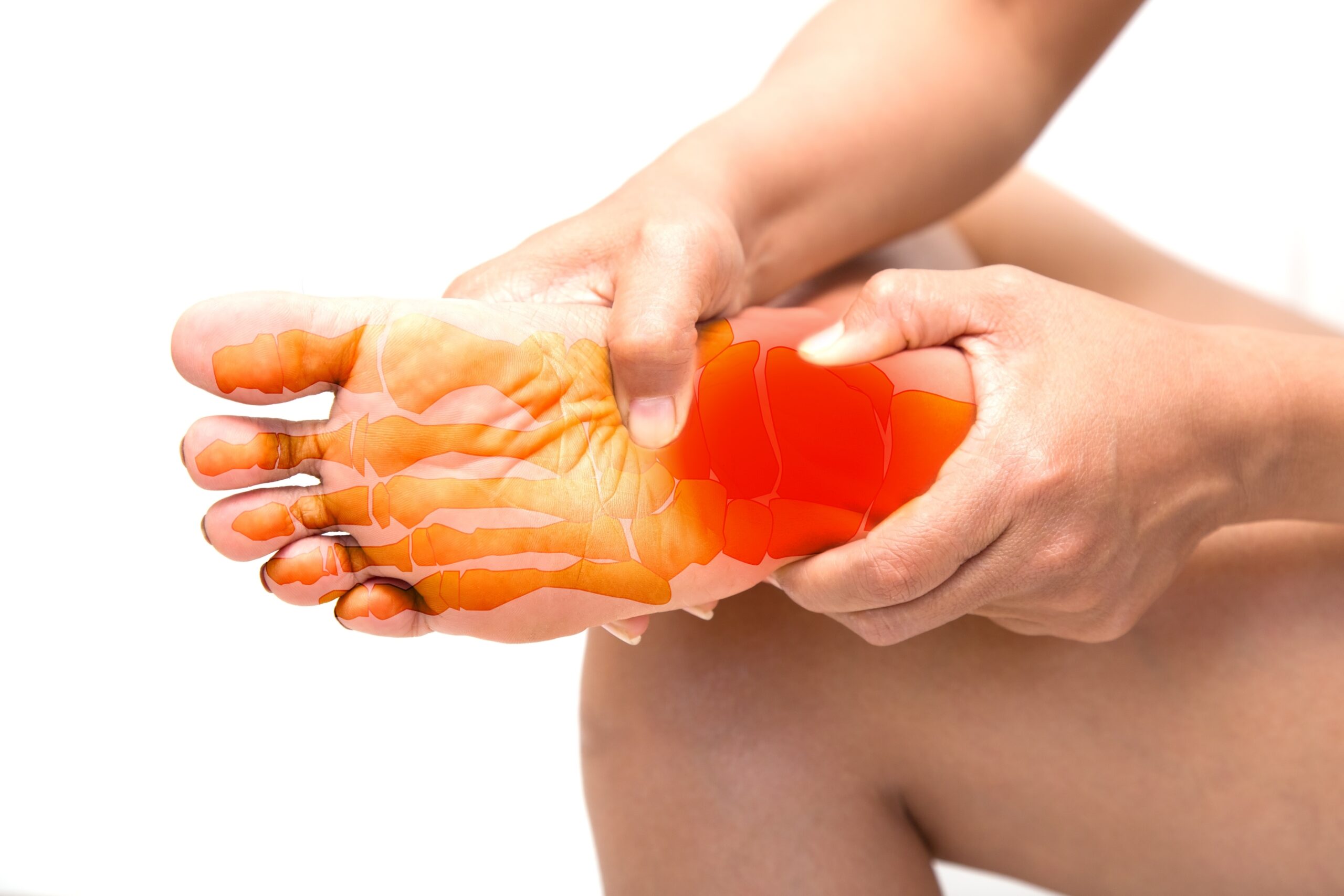
Does standing all day cause plantar fasciitis?
It raises the risk, though the proof is weaker than most people assume.
- In a case-control study of 50 patients and 100 matched controls, people who spent most of the workday on their feet had 3.6 times the odds of plantar fasciitis.
- In a study of workers at an engine assembly plant, more time standing on hard surfaces and more time walking were both linked to plantar fasciitis found on examination.
- A national database study from Taiwan followed 127,455 nurses for seven years. About 13% were diagnosed with plantar fasciitis in that time, compared with about 8% of physicians. Against the general population, though, the nurses' risk was only slightly higher.
- A 2015 systematic review pulled the workplace studies together. It found only four, all with design weaknesses, and concluded there was low-quality evidence of a link between plantar fasciitis and standing or walking on hard surfaces.
The American Academy of Orthopaedic Surgeons (AAOS) lists standing for long periods on hard surfaces as a risk factor and names healthcare workers, factory workers and teachers. So the link is accepted, but standing is rarely the whole story. In the same case-control study, a stiff ankle from a tight calf and a higher body weight were stronger risk factors than standing was.
Why long shifts are hard on the fascia
The plantar fascia stretches and recoils with every step and holds up your arch while you stand. Hours of that on a hard floor add up to repetitive strain with little recovery time. Many workers notice the classic pattern: sharp pain with the first steps after a break or after the drive home, easing as they move, then a deep ache by the end of the shift. Our page on morning heel pain explains why the first steps are the worst.
What helps at work, and how good the evidence is
| Change | What the evidence says | How strong it is |
|---|---|---|
| Cushioned insoles or heel pads | In a randomized trial of 236 patients, adding a prefabricated insert to stretching improved more people at eight weeks (81% to 95%, depending on the insert) than stretching alone (72%) or a custom orthotic (68%). | Moderate for short-term relief |
| Custom orthotics | A pooled analysis of 19 trials found orthoses reduced pain modestly at 7 to 12 weeks, and that custom devices did no better than prefabricated ones. | Moderate, with no proven edge over off-the-shelf |
| Softer flooring or anti-fatigue mats | A review of 10 studies found moderate evidence that cushioned surfaces reduce discomfort and fatigue in standing workers, and limited evidence that insoles do this better than mats. | Moderate for comfort. Not tested for plantar fasciitis itself. |
| Rotating shoes | Assembly plant workers who rotated their shoes during the work week had a lower risk of plantar fasciitis. | One observational study |
| Alternating sitting and standing | Suggested by the assembly plant researchers and by occupational safety guidance. | Expert recommendation |
| Stretching | The AAOS calls calf and plantar fascia stretching the most effective way to relieve plantar fasciitis pain. | Supported by several treatment trials |
Footwear
No trial tells us the single best work shoe. Canadian occupational safety guidance for standing work recommends shoes with arch support, a firm grip at the heel, room for the toes and a lace-up closure, plus a shock-absorbing cushioned insole when you work on metal or cement floors. It advises against shoes with no arch support or cushioning and against very high heels. If you can, keep two pairs and alternate them.
Insoles: start simple
The trial data point the same way: an inexpensive prefabricated insert or heel pad is a reasonable first step, and paying more for a custom device does not buy a better result on average. An older Cochrane review made a point of this for people who stand more than eight hours a day, noting limited evidence that stretching and heel pads did better than custom orthoses in that group.
Mats and floors
The safety guidance recommends wood, cork or rubber-covered floors over bare concrete or metal, and mats where the floor cannot be changed. Thicker is not better. The same guidance warns against thick foam mats, because too much cushioning can cause fatigue and raise the risk of tripping.
Movement and stretching breaks
Staying locked in one position is as much the problem as standing itself. A foot rail or small footrest lets you shift weight from one leg to the other, and a stool lets you sit for tasks that allow it. In a survey of 162 women in standing jobs, almost 60% said discomfort began after about three hours of continuous standing, which is a fair argument for building in a change of position before then.
Use breaks to stretch. The AAOS describes two stretches: a wall calf stretch, and a seated stretch where you pull your toes back toward your shin. Each is held for 10 seconds and repeated 20 times. The seated stretch is best done before your first steps of the day, so before you leave for work, and it makes sense to repeat it before you stand up after a long break.
Questions about your treatment options? Dr. Fox can help.
Book a ConsultationThis article is part of our Heel Pain Guide.
Tips by type of job
- Nurses and other healthcare workers. Sit for charting when you can, change shoes mid-shift if your unit allows it, and stretch before you get out of the car at home.
- Teachers. You control your room more than most workers do. A tall stool at the board and a small mat where you stand most can break up the day.
- Retail and restaurant workers. Counters and kitchens often sit on tile or concrete. A mat at a fixed station and a cushioned insole are the two changes most within reach.
- Construction, warehouse and factory workers. Safety footwear comes first. Choose a boot that fits the hazard and fits your foot, then add a cushioned insole inside it. If you climb in and out of a vehicle all day, note that this was also linked to plantar fasciitis in the assembly plant study.
These are practical suggestions, not study findings for each occupation.
Talking to your employer
Most of the changes above are small and inexpensive, which makes them easier to ask for. Some approaches that tend to work:
- Be specific. "A mat at register three" or "a stool at the charting station" is easier to approve than "my feet hurt."
- Ask about task rotation, so that standing tasks alternate with seated or walking ones.
- Ask whether your workplace has a footwear allowance or lets you bring your own insoles for safety boots.
- If you need a temporary change in duties, a note from your doctor describing what you can and cannot do is usually the starting point.
In the assembly plant study, workers who reported more supervisor support tended to have less plantar fasciitis, although that trend did not reach statistical significance. Rules on workplace accommodations vary by employer and location, so your human resources office or union representative is the right source for what applies to you.
When to see a doctor
Give consistent self-care a fair trial of several weeks. See a doctor if the pain is not improving, is getting worse, or is affecting your ability to do your job. Pain that lasts more than about three months without responding is the point where doctors consider imaging to look for another cause. Our guide to which doctor to see can help you pick a starting point.
Be seen promptly, not at your next routine visit, if you felt a pop or tearing in the heel, cannot put weight on the foot, have numbness or burning that is spreading, notice redness, warmth or fever, have a swollen and tender calf, or have a foot that turns cold or pale.
If the job cannot change and the pain will not quit
Some workers do everything right and still have heel pain after six months or a year. That is chronic plantar fasciitis, and it has its own set of options, which we walk through in plantar fasciitis that won't go away and the wider heel pain guide.
One of those options is plantar fasciitis embolization (PFE), which Dr. Fox performs. It is a catheter procedure done through an artery that reduces blood flow in the small abnormal vessels around a long-irritated fascia. The evidence is early: in a 2026 prospective series, 17 of 24 patients (70.8%) responded at six months. Studies so far are small, have no comparison group, and none is a randomized trial.
One finding matters for people in standing jobs. In a 2026 study of 32 patients, 5 (15.6%) had a mild return of symptoms after embolization, and all five worked in physically demanding occupations. They were managed with insoles and did not need a repeat procedure. In other words, the demands of your job still count after any treatment, which is also the theme of our article on why plantar fasciitis keeps coming back. You can read how the procedure works on our plantar fasciitis embolization page and in the embolization guide.
Frequently Asked Questions
Is plantar fasciitis caused by standing all day?
Standing is a recognized risk factor. One case-control study found 3.6 times the odds in people who spent most of the workday on their feet, but a systematic review rated the overall evidence as low quality, and calf tightness and body weight were stronger factors.
Are custom orthotics worth it for a standing job?
Not as a first step. In pooled trials, custom orthotics did no better than prefabricated inserts, and one randomized trial found prefabricated inserts plus stretching improved more people at eight weeks than a custom device plus stretching.
Do anti-fatigue mats help plantar fasciitis?
They have moderate evidence for reducing discomfort and fatigue in standing workers, but they have not been tested for plantar fasciitis specifically. Very thick foam mats are not recommended because they can add fatigue and create a trip hazard.
What are the best shoes for standing all day with plantar fasciitis?
No trial identifies one best shoe. Occupational safety guidance recommends arch support, a firm heel grip, toe room, laces and a cushioned insole on hard floors, and one workplace study linked rotating between pairs to lower risk.
Can I have embolization and keep a job on my feet?
That is a question for a consultation. In one 2026 study, 5 of 32 patients with physically demanding jobs had a mild return of symptoms after embolization, so job demands still matter and insoles and stretching remain part of the plan.
Keep Reading
- Plantar Fasciitis Embolization (PFE) in Manhattan
- Plantar Fasciitis Surgery: Recovery, Success Rates and Risks
- TAME, TAE, PFE and Microembolization: Are They the Same Procedure?
- Plantar Fasciitis That Won't Go Away: A Practical Next-Step Plan
- Shockwave Therapy for Plantar Fasciitis Did Not Work. What Are Your Options?
- What If Plantar Fasciitis Embolization (PFE) Does Not Work?
- Heel Pain Guide: causes, treatments and PFE
Sources
- American Academy of Orthopaedic Surgeons, OrthoInfo: Plantar fasciitis and bone spurs
- Trojian T, Tucker AK, American Family Physician, 2019: Plantar fasciitis
- Riddle DL et al., J Bone Joint Surg Am, 2003: Risk factors for plantar fasciitis, matched case-control study of 50 patients
- Werner RA et al., PM R, 2010: Risk factors for plantar fasciitis among assembly plant workers, cross-sectional study
- Waclawski ER et al., Occup Med (Lond), 2015: Plantar fasciitis and prolonged weight bearing, systematic review of 4 studies
- Sung KC et al., Ind Health, 2020: Plantar fasciitis in physicians and nurses, nationwide population-based study
- Pfeffer G et al., Foot Ankle Int, 1999: Custom and prefabricated orthoses in the initial treatment of plantar fasciitis, randomized trial of 236 patients
- Whittaker GA et al., Br J Sports Med, 2018: Foot orthoses for plantar heel pain, meta-analysis of 19 trials
- Crawford F, Thomson C, Cochrane Database Syst Rev, 2003: Interventions for treating plantar heel pain
- Speed G et al., Appl Ergon, 2018: Cushioning materials and discomfort during prolonged standing at work, systematic review of 10 studies
- Dutta K et al., Indian J Occup Environ Med, 2026: Discomfort from extended standing at work, survey of 162 women
- Canadian Centre for Occupational Health and Safety: Working in a standing position, basic information
- Gill S et al., J Vasc Interv Radiol, 2026: Transarterial embolization for plantar heel pain, 6-month prospective case series of 24 patients
- Tonkaz M, Bekci T, Eur J Radiol, 2026: Embolization for plantar fasciitis, prospective single-center study of 32 patients
Medically reviewed by David Fox, MD, FACS, RPVI. This article is general information, not a substitute for a medical evaluation.
Living with joint or tendon pain that hasn’t improved? Schedule a consultation with Dr. David Fox at Fox Vein & Vascular in Manhattan to find out whether embolization is right for you. Call (212) 362-3470 or request an appointment online.
