
"Radiofrequency" shows up in two quite different heel pain procedures, and both are sometimes offered to the same people who ask about plantar fasciitis embolization (PFE): those whose pain has outlasted stretching, inserts and injections. This guide explains how each one works, what has been published and where the gaps are. Dr. Fox performs PFE and does not perform radiofrequency procedures, so we have tried to describe them the way their own research does.
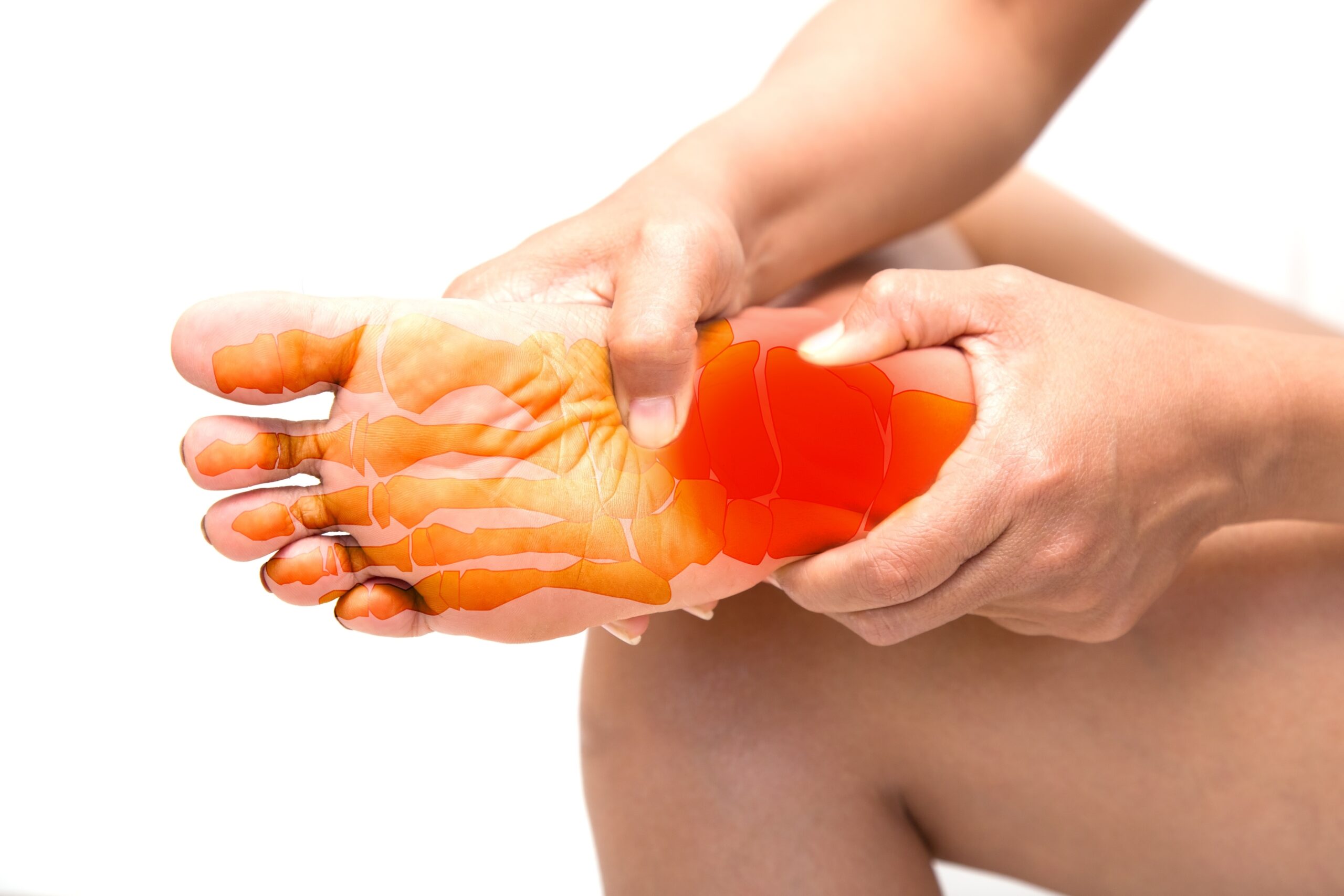
Three procedures, three different targets
Radiofrequency nerve ablation (RFNA) targets the small sensory nerves that carry pain signals from the heel. A thin probe is placed through the skin next to the nerve branch, and radiofrequency energy heats the tip to interrupt the nerve's signal. Studies have treated branches of the medial calcaneal nerve, the inferior calcaneal nerve (also called the first branch of the lateral plantar nerve), or both. A gentler variation called pulsed radiofrequency aims to quiet the nerve without destroying it.
Radiofrequency microtenotomy targets the plantar fascia itself. It is widely known by the brand name Topaz, after the wand used in most studies. The surgeon applies brief pulses of radiofrequency energy at a series of small points in the damaged fascia, either through tiny skin punctures or through a small incision. It is a fascia procedure, not a nerve procedure.
PFE targets the abnormal small blood vessels that can form around a chronically irritated plantar fascia. A vascular specialist reaches a small artery under imaging guidance and delivers tiny particles that reduce flow through those vessels. Nothing in the heel is cut or heated. Our plantar fasciitis embolization page describes the steps.
What the research shows for radiofrequency nerve ablation
RFNA has something neither of the other two has: a randomized, sham-controlled study, though a very small one.
- Landsman and colleagues, 2013 (randomized, double-blinded, sham-controlled with crossover, 17 patients). Eight patients had the real treatment first and nine had a sham. The treated group improved significantly and the sham group did not. Sham patients who crossed over to real treatment after 4 weeks then improved as well.
- Liden and colleagues, 2009 (retrospective, 22 patients, 31 feet). Average pain fell from 8.12 out of 10 to 1.46 at 1 month and was 2.07 at 6 months. The only adverse events were bruising and blood collecting at the probe entry site.
- Erken and colleagues, 2014 (case series, 29 patients, 35 feet, 2-year follow-up). Average pain fell from 9.2 to 1.3 out of 10 at 2 years, and 85.7% of patients rated the treatment successful or very successful.
- Arslan and colleagues, 2016 (37 patients, 41 feet). Patients first had numbing injections to confirm that a nerve was the source of pain. At 12 months, 88% rated the treatment successful or very successful.
- Kurtoglu and colleagues, 2022 (retrospective, 261 patients, 378 feet). Pain and function scores improved significantly by 1 month and held at final follow-up, which ranged from 8 to 24 months.
- Cozzarelli and colleagues, 2010 (retrospective, 82 patients). In telephone interviews at 5, 10 and 12 years, 89% reported no recurrence of pain. In that practice the procedure was done under general anesthesia and took about 15 to 20 minutes per heel.
For pulsed radiofrequency, a 2017 randomized, placebo-controlled trial of 36 patients found greater improvement in pain and function than a numbing injection at every check through 12 weeks.
The fair summary: one tiny randomized study, one small randomized trial of the pulsed version with short follow-up, and several uncontrolled series with good reported results. Most follow-up relied on patient questionnaires.
What the research shows for radiofrequency microtenotomy
- Weil and colleagues, 2008 (prospective, 10 patients). All improved at 6 months and 1 year. One had pain return at 1 year. No complications were reported.
- Sean and colleagues, 2010 (14 patients). Average foot function scores rose from 34.47 to 71.33 at 6 months, and 12 of 14 reported good to excellent satisfaction.
- Tay and colleagues, 2012 (prospective, non-randomized, 48 patients, 59 feet). Pain improved at 1 year with both the open and the skin-puncture method, with somewhat more pain improvement in the open group.
- Lucas and colleagues, 2015 (mailed questionnaire). Of 111 patients, 61 replied at an average of 33.3 months. Of those, 51 (83.6%) were satisfied.
- Wang and colleagues, 2018 (comparative study). Endoscopic plantar fascia release gave earlier improvement at 3 months, but results were equivalent to open microtenotomy at 1 year.
A 2022 systematic review of 11 articles rated the evidence as fair and called for high-quality randomized trials. A 2025 meta-analysis of 15 studies with 1,576 patients reported an average pain reduction of 5.90 points on a 10-point scale and a complication rate of 3.00%. Its included studies were clinical trials, cohort studies and case series, so the pooled numbers carry the limits of those designs.
Questions about your treatment options? Dr. Fox can help.
Book a ConsultationThis article is part of our Heel Pain Guide.
What the research shows for PFE
PFE is the newest of the three, and its evidence is the earliest.
- Gill and colleagues, 2026 (prospective case series, 24 people). 17 of 24 (70.8%) met the study's responder definition at 6 months. No adverse events occurred.
- Kumar and colleagues, 2026 (retrospective, 12 patients). Of 11 who could be treated, 8 (72.7%) had at least a 50% drop in pain at 6 months, sustained through 12 months.
- Tonkaz and Bekci, 2026 (prospective, 32 patients). Average pain fell from 7.3 to 1.3 out of 10 at 6 months. Five patients with physically demanding jobs had a mild return of symptoms.
- Sasaki and colleagues, 2025 (retrospective, 66 patients). Results held at an average follow-up of 30.9 months, with no major adverse events.
None of these studies had a comparison group, and there is no randomized or sham-controlled trial of PFE for plantar fasciitis.
There is no head-to-head trial
We searched PubMed for a study comparing embolization with either radiofrequency procedure for plantar fasciitis and found none. The studies above used different patients, different pain scales and different definitions of success, so their percentages cannot be lined up to pick a winner.
| RF nerve ablation | RF microtenotomy (Topaz) | PFE | |
|---|---|---|---|
| What it targets | Small pain-carrying nerve branches | Damaged plantar fascia tissue | Abnormal small blood vessels |
| How it reaches the target | Probe through the skin of the heel | Wand through skin punctures or a small incision | Through an artery |
| Largest study found | 261 patients, retrospective | Meta-analysis of 15 studies | 66 patients, retrospective |
| Sham-controlled trial | One, 17 patients | None found | None |
| Longest follow-up found | Telephone interviews at up to 12 years | Average 33.3 months | Average 30.9 months |
Who each may suit
These are general patterns to raise with your doctors, not rules.
RF nerve ablation may be worth asking about if your pain has a nerve quality, such as burning, or if a numbing injection near the heel nerves takes the pain away for a while. One study used exactly that kind of test injection to select patients. It is also an option some foot specialists offer when they want to avoid cutting the fascia.
RF microtenotomy may be worth asking about if imaging shows a thickened, degenerated fascia and you are already working with a foot and ankle surgeon who performs it.
PFE may be worth asking about if your plantar fasciitis is confirmed, has lasted many months despite conservative care, and you prefer an approach that does not cut, heat or remove tissue in the heel. It may not be suitable if you have poor circulation in the legs, kidney disease or a past reaction to contrast dye. See who is a candidate for PFE.
None of them is right if the diagnosis is uncertain. A stress fracture or fat pad problem will not respond to any of the three. Our guide to conditions mistaken for plantar fasciitis explains how these are sorted out.
Risks to weigh
The studies above reported few problems, but small studies cannot rule out uncommon ones. For nerve ablation, one series reported bruising at the probe site, and because the treated nerves carry sensation, it is reasonable to ask about numbness afterward. For microtenotomy, case reports describe skin cysts forming on the heel that needed surgical removal. For PFE, published series report no major adverse events, but it is an artery procedure, and a 2026 case report describes a blocked lower-leg artery after PFE done through an artery in the foot.
Questions to ask before you choose
- Is my pain coming from the fascia, a nerve or both, and how do you know?
- What kind of anesthesia do you use?
- What will my first two weeks look like, and when can I return to my usual activity?
- If this does not help, what would you suggest next, and does this procedure limit my other options?
Dr. Fox is a board-certified vascular surgeon. If your history suggests a nerve-focused or fascia-focused procedure makes more sense, he will say so and refer you back to a foot and ankle specialist.
For other comparisons, see PFE versus Tenex, alternatives to plantar fasciitis surgery and plantar fasciitis surgery recovery and success rates. The heel pain guide lists every article in this series, and the embolization guide covers other joints.
Frequently Asked Questions
Is embolization more effective than radiofrequency ablation for plantar fasciitis?
No one knows. No study has compared them head to head. Radiofrequency nerve ablation has one very small sham-controlled study, and PFE so far has only small series without a comparison group.
Is Topaz the same as radiofrequency nerve ablation?
No. Topaz is a radiofrequency microtenotomy that treats the plantar fascia tissue. Radiofrequency nerve ablation treats the small nerve branches that carry pain from the heel.
Does Dr. Fox perform radiofrequency ablation?
No. Dr. Fox is a vascular surgeon and performs embolization. Radiofrequency procedures for heel pain are offered by foot and ankle specialists and some pain specialists.
Can I have PFE if radiofrequency ablation did not help?
Possibly, but this has not been studied. It depends on your diagnosis, imaging and health history, so it needs an individual evaluation.
Keep Reading
- Plantar Fasciitis Embolization (PFE) in Manhattan
- Plantar Fasciitis Embolization vs. Tenex: How the Two Compare
- Do You Need an MRI, Ultrasound or X-Ray for Plantar Fasciitis?
- Plantar Fasciitis When You Stand All Day at Work
- Plantar Fasciitis Surgery: Recovery, Success Rates and Risks
- TAME, TAE, PFE and Microembolization: Are They the Same Procedure?
- Heel Pain Guide: causes, treatments and PFE
Sources
- Landsman AS et al., J Am Podiatr Med Assoc, 2013: Radiofrequency nerve ablation for heel pain, randomized double-blinded sham-controlled study with crossover, 17 patients
- Liden B et al., J Foot Ankle Surg, 2009: Percutaneous radiofrequency nerve ablation for heel pain associated with plantar fasciitis, retrospective analysis of 22 patients
- Erken HY et al., Foot Ankle Int, 2014: Percutaneous radiofrequency nerve ablation for chronic plantar fasciitis, 35 feet in 29 patients, 2-year follow-up
- Arslan A et al., J Foot Ankle Surg, 2016: Radiofrequency neural ablation of the first branch of the lateral plantar nerve and medial calcaneal nerve branches, 37 patients
- Kurtoglu A et al., Medicine (Baltimore), 2022: Radiofrequency ablation for plantar fasciitis, retrospective review of 261 patients
- Cozzarelli J et al., Foot Ankle Spec, 2010: 12-year retrospective analysis of radiofrequency nerve ablation for neurogenic heel pain, 82 patients
- Wu YT et al., Arch Phys Med Rehabil, 2017: Ultrasound-guided pulsed radiofrequency of the posterior tibial nerve for recalcitrant plantar fasciitis, randomized trial of 36 patients
- Osman AM et al., Pain Physician, 2016: Pulsed compared to thermal radiofrequency to the medial calcaneal nerve for chronic refractory plantar fasciitis, prospective comparative study of 20 patients
- Weil L Jr et al., Foot Ankle Spec, 2008: Bipolar radiofrequency microtenotomy for plantar fasciosis, prospective study of 10 patients
- Sean NY et al., Foot Ankle Surg, 2010: Radiofrequency microtenotomy for plantar fasciitis, 14 patients
- Tay KS et al., Foot Ankle Surg, 2012: Open vs. percutaneous TOPAZ radiofrequency coblation for plantar fasciitis, prospective non-randomized trial of 48 patients
- Lucas DE et al., J Foot Ankle Surg, 2015: Intermediate-term results of bipolar radiofrequency microtenotomy, mailed questionnaire, 61 of 111 patients
- Wang W et al., Foot Ankle Int, 2018: Endoscopic plantar fasciotomy vs. open radiofrequency microtenotomy for recalcitrant plantar fasciitis, comparative study
- Thor J et al., Foot (Edinb), 2022: Radiofrequency microtenotomy for plantar fasciitis, systematic review and meta-analysis of 11 articles
- Domingo-Marques S et al., J Clin Med, 2025: Radiofrequency by the Topaz technique for chronic plantar fasciopathy, systematic review and meta-analysis of 15 studies
- Skolnik J et al., J Foot Ankle Surg, 2021: Multiple epidermal inclusion cysts after radiofrequency microtenotomy for plantar fasciitis, case report
- Gill S et al., J Vasc Interv Radiol, 2026: Transarterial embolization for plantar heel pain, 6-month prospective case series of 24 patients
- Kumar N et al., J Vasc Interv Radiol, 2026: Superselective embolization with imipenem/cilastatin for refractory plantar fasciitis, retrospective series of 12 patients
- Tonkaz M, Bekci T, Eur J Radiol, 2026: Medial calcaneal artery embolization for plantar fasciitis, prospective study of 32 patients
- Sasaki T et al., Foot Ankle Surg, 2025: Ultrasound-guided intra-arterial embolization for plantar fasciitis, 66 patients
- Tan JT et al., J Vasc Interv Radiol, 2026: Anterior tibial artery occlusion after embolization for plantar fasciitis, case report
Medically reviewed by David Fox, MD, FACS, RPVI. This article is general information, not a substitute for a medical evaluation.
Living with joint or tendon pain that hasn’t improved? Schedule a consultation with Dr. David Fox at Fox Vein & Vascular in Manhattan to find out whether embolization is right for you. Call (212) 362-3470 or request an appointment online.
