
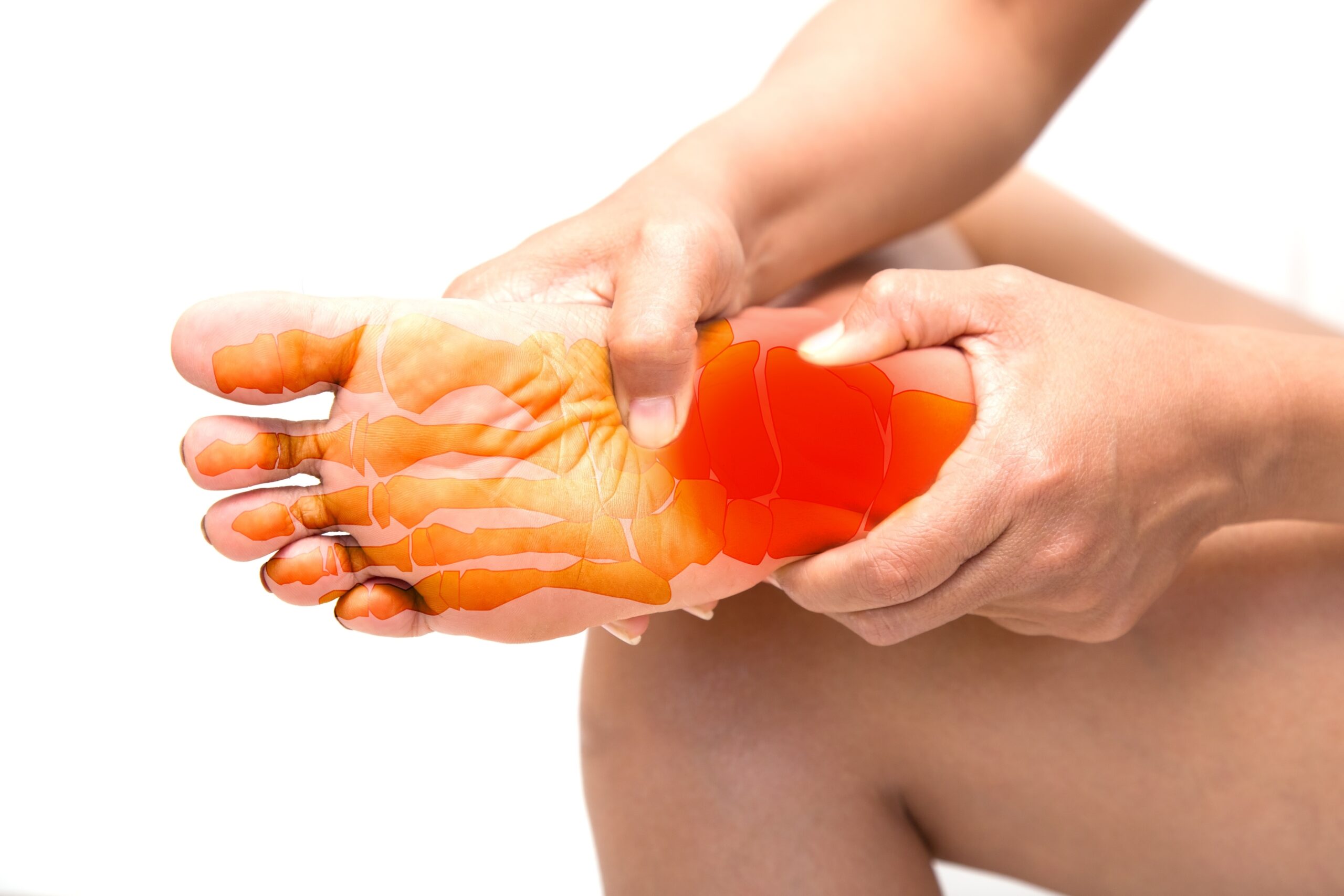
If you run, play a sport or train hard, plantar fasciitis can feel like more than a sore heel. It can take away the thing you use to stay healthy and clear your head. This guide is for active people who have done the rehab, changed their shoes, cut their mileage and still have heel pain months later. It explains where plantar fasciitis embolization (PFE) fits, what the research does and does not show for active patients, and how to think about getting back to training.
Why plantar fasciitis is so common in runners
The American Academy of Orthopaedic Surgeons lists repetitive high-impact activity such as running, dancing and sports, and new or increased activity, as risk factors for plantar fasciitis. In athletes, it is usually an overuse problem. A 2021 review of 16 studies in physically active people also linked it to higher body weight and to greater ankle plantarflexion range of motion.
The classic pattern is pain with your first steps in the morning or after sitting, and pain that is often worse after a run than during it. That second point matters, because it is one way a doctor tells plantar fasciitis apart from other causes of heel pain in runners.
The good news is that most cases settle with simple care. According to the AAOS, more than 90% of people with plantar fasciitis improve within 10 months of starting simple treatment. That includes rest and activity changes, low-impact training such as cycling or swimming, calf and plantar fascia stretching, supportive shoes or orthotics, night splints and physical therapy.
Where PFE fits for an active patient
PFE is not a shortcut past rehab. It is an option for heel pain that has lasted many months despite a real effort at conservative care. In published PFE studies, patients had usually failed at least 3 to 6 months of conservative treatment before embolization.
The idea behind PFE is that long-lasting plantar fasciitis can develop small abnormal blood vessels around the inflamed tissue. Using X-ray guidance, a thin catheter is placed in an artery and tiny particles are used to reduce blood flow through those abnormal vessels. You can read the full procedure overview on our plantar fasciitis embolization page.
For athletes, the appeal is easy to see. A 2023 review of embolization for overuse sports injuries by Dr. Yuji Okuno, who pioneered this approach, noted that athletes need a quick return to activity and treatments with short periods of missed practice, and that embolization may be able to meet that need. That paper was a set of case reports, though, not a trial, so it describes a possibility rather than a proven result.
What the research shows, honestly
PFE is an early-stage treatment. As of October 2026, the published studies are small case series and retrospective reviews, and we did not find any randomized or sham-controlled PFE trials. None of the studies looked only at runners, and none published a return-to-running timeline. Here is what the main recent studies found:
| Study | Who was treated | What it found |
|---|---|---|
| Gill et al., 2026 (prospective case series) | 24 people with long-lasting heel pain who had tried other treatments | 17 of 24 (70.8%) met the responder definition at 6 months. Scores for sports and recreation improved. No adverse events. |
| Kumar et al., 2026 (retrospective) | 12 patients, average age 36 | 8 of 11 treated patients (72.7%) had at least a 50% drop in pain at 6 months, sustained to 12 months. |
| Tonkaz and Bekci, 2026 (prospective) | 32 patients | Average pain fell from 7.3 to 1.3 out of 10 at 6 months. Mild recurrence in 5 patients (15.6%) who had physically demanding jobs. |
| Sasaki et al., 2025 (retrospective) | 66 patients | Foot function scores rose from 65.8 to 92.8 at 1 year, and results held at an average follow-up of 30.9 months. |
| Astani et al., 2026 (retrospective) | 41 feet in 34 patients | 5 feet (12%) needed a repeat procedure within 6 months. |
Two points stand out for athletes. First, the Gill study measured sports and recreation function directly and found it improved, which is encouraging. Second, the Tonkaz study saw pain return mainly in people whose feet took heavy daily loads. That fits what runners already know: if the load that caused the problem does not change, the problem can come back. For a deeper look at the studies, see our page on PFE clinical evidence.
Questions about your treatment options? Dr. Fox can help.
Book a ConsultationThis article is part of our Embolization Guide.
This article is part of our Heel Pain Guide.
Is your heel pain really plantar fasciitis?
Runners get several kinds of heel pain, and embolization is only studied for plantar fasciitis. Before any procedure, a doctor should rule out other causes the AAOS specifically names, including:
- A heel (calcaneal) stress fracture. The heel bone is the second most common place in the foot for stress fractures, and they are common in runners. Pain usually builds gradually and gets worse during weight-bearing activity.
- Nerve entrapment. Burning, tingling or numbness points toward a nerve problem rather than the fascia.
- Insertional Achilles tendinitis. Pain at the back of the heel, where the Achilles tendon attaches, is a different condition.
Getting this right is the most important step. Embolization will not heal a stress fracture, and running on one can make it worse. Our guide to who is a candidate for PFE walks through the rest of the evaluation.
Training before and after PFE
Because no study has set a return-to-running schedule, your plan should come from Dr. Fox and, ideally, a physical therapist who knows your sport. In general:
- Right after the procedure, walking is usually allowed the same day, but running and jumping are not. Our walking and activity guide covers the first weeks in detail.
- Low-impact work first. Cycling and swimming are the kinds of low-impact training the AAOS suggests for plantar fasciitis, and they can help you keep fitness while the heel settles.
- Running only after clearance. Dr. Fox decides when you can return to running and high-impact sport, based on how your heel responds. Expect a gradual build, not a jump back to your old mileage.
- Keep the rehab. Embolization does not change your calf flexibility, your shoes or your training load. Stretching, strengthening and smart mileage still matter after PFE.
Pain relief also varies. In the Kumar study pain dropped noticeably by the day after treatment, while other studies measured gains over weeks to months. Our PFE recovery timeline explains what to expect week by week.
Who may not be a good fit
PFE may not be the right choice if:
- Your heel pain is recent or you have not yet tried a full course of conservative care.
- Your symptoms suggest a stress fracture, a nerve problem or an Achilles problem instead.
- You have had a sudden injury rather than gradual overuse pain.
- You have health issues that make an artery procedure riskier, such as poor circulation in the legs, kidney disease or a past reaction to X-ray contrast dye. Dr. Fox reviews these at your consultation.
If you play several sports or have pain in more than one joint, you can also browse our embolization guide, which covers the knee, heel, shoulder, elbow and hip in one place.
Risks to weigh
In the PFE studies above, serious complications were not reported, and a 2026 review of foot and ankle embolization described reported complications as minor and temporary. The same review stressed that the evidence comes from small, lower-quality studies. As with other catheter procedures, mild soreness or bruising where the catheter goes in can occur. Rare problems can happen with any artery procedure. A 2026 case report, for example, described a blocked artery in the lower leg after PFE performed through an artery in the foot. Ask Dr. Fox how he chooses the access site and what signs to watch for.
When to get help right away
Do not wait for a scheduled visit if you have heel pain that came on suddenly with swelling or you cannot put weight on your foot, or pain that gets sharply worse while you run with tenderness right over the bone. These can be signs of a fracture. After any embolization, call the office at once, or go to an emergency room, if your foot turns cold, pale or numb, if the access site bleeds or swells quickly, or if you have spreading redness or a fever.
Frequently Asked Questions
Can I keep running before my PFE consultation?
That depends on your diagnosis and how your heel responds to running. If running makes the pain sharply worse during activity, stop and get evaluated, because a stress fracture needs to be ruled out first.
How soon can I run after plantar fasciitis embolization?
No published study has set a return-to-running timeline. Walking is usually allowed the same day, and Dr. Fox clears you for running and high-impact sport only after checking how your heel has responded.
Will PFE stop my plantar fasciitis from coming back?
Not on its own. In one 2026 study of 32 patients, pain returned mildly in 5 people with physically demanding jobs, so managing training load, shoes and calf flexibility still matters after the procedure.
Is PFE only for elite athletes?
No. Published studies treated adults with long-lasting plantar fasciitis whether or not they played sports. What matters most is the diagnosis and whether months of conservative care have already failed.
Keep Reading
- Plantar Fasciitis Embolization (PFE) in Manhattan
- Plantar Fasciitis Embolization vs. Radiofrequency Ablation and Topaz: How They Compare
- Plantar Fasciitis Embolization vs. Tenex: How the Two Compare
- Do You Need an MRI, Ultrasound or X-Ray for Plantar Fasciitis?
- Plantar Fasciitis When You Stand All Day at Work
- Plantar Fasciitis Surgery: Recovery, Success Rates and Risks
- Heel Pain Guide: causes, treatments and PFE
Sources
- Gill S et al., J Vasc Interv Radiol, 2026 — Transarterial embolization for plantar heel pain: 6-month prospective case series
- Kumar N et al., J Vasc Interv Radiol, 2026 — Superselective embolization with imipenem/cilastatin for refractory plantar fasciitis
- Tonkaz M, Bekci T, Eur J Radiol, 2026 — Superselective medial calcaneal artery embolization for plantar fasciitis
- Sasaki T et al., Foot Ankle Surg, 2025 — Intra-arterial embolization for plantar fasciitis: 66 cases with up to 4 years of follow-up
- Astani SA et al., J Vasc Interv Radiol, 2026 — Super-selective embolization of plantar fasciitis with resorbable embolics
- Okuno Y, Cardiovasc Intervent Radiol, 2023 — Transarterial embolization for refractory overuse sports injury: pictorial case reports
- Tan JT et al., J Vasc Interv Radiol, 2026 — Anterior tibial artery occlusion after embolization for plantar fasciitis (case report)
- Mazzotti A et al., Musculoskelet Surg, 2026 — Transcatheter arterial microembolization in foot and ankle pathologies: review
- Tonkaz M et al., J Vasc Interv Radiol, 2026 — Artery diameter ratio as a predictor of response after embolization for plantar fasciitis (38 patients, ≥6 months failed conservative care)
- British Society of Interventional Radiology — Genicular artery embolisation patient information (catheter-site discomfort and bruising)
- Hamstra-Wright KL et al., Sports Health, 2021 — Risk factors for plantar fasciitis in physically active individuals
- American Academy of Orthopaedic Surgeons, OrthoInfo — Plantar fasciitis and bone spurs
- American Academy of Orthopaedic Surgeons, OrthoInfo — Stress fractures of the foot and ankle
Medically reviewed by David Fox, MD, FACS, RPVI. This article is general information, not a substitute for a medical evaluation.
Living with joint or tendon pain that hasn’t improved? Schedule a consultation with Dr. David Fox at Fox Vein & Vascular in Manhattan to find out whether embolization is right for you. Call (212) 362-3470 or request an appointment online.
