
If you have been reading about embolization for stubborn heel pain, you have probably run into a pile of abbreviations: TAME, TAE, PFE, microembolization, and sometimes "the Okuno procedure." It is easy to assume these are competing treatments. Mostly, they are not. They are different names for the same basic idea, with some real differences in technique hiding underneath. This guide sorts out which is which.
The short version
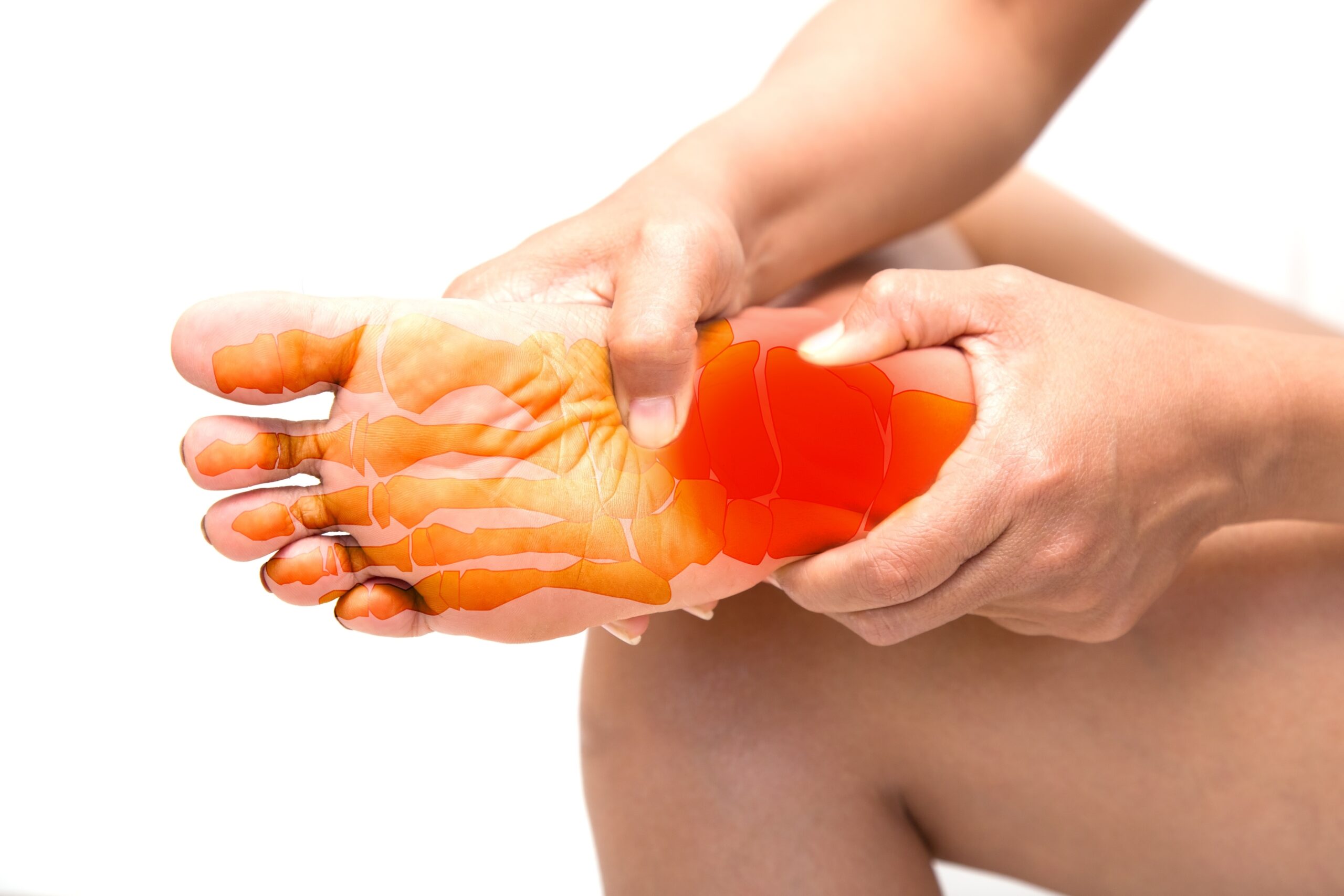
All of these terms describe a procedure in which a specialist reaches a small artery near the heel and delivers tiny particles that reduce blood flow through abnormal vessels around the plantar fascia. Long-lasting plantar fasciitis can develop these extra vessels, and studies describe them as a "blush" on X-ray imaging at the spot where the fascia attaches to the heel bone.
The name tells you very little about how the procedure is done. Two clinics can both advertise "TAME" and use different materials and a different way into the artery. Two others can use different names and do nearly the same thing. What matters is the technique, not the label.
Where each name comes from
| Name | What it stands for | Where it appears in the research |
|---|---|---|
| TAE | Transcatheter arterial embolization, or transarterial embolization | The 2013 report by Dr. Yuji Okuno and colleagues, and the 2024 and 2026 plantar fasciitis series by Gandhi, Gill and Kumar |
| TAME | Transcatheter arterial microembolization, or transarterial microembolization | A 2026 review of foot and ankle embolization, a 2025 Achilles tendon study of 82 patients, and a 2024 paper on complications |
| Intra-arterial embolization or infusion | A plain description of delivering the material into an artery | A 2021 case report and a 2025 series of 66 patients from Dr. Okuno's clinics |
| PFE | Plantar fasciitis embolization | A 2026 series of 41 legs in 34 patients from a United States practice |
| Medial calcaneal artery embolization | Named for the small heel artery that is treated | A 2026 prospective study of 32 patients |
| MSK embolization | Musculoskeletal embolization, the umbrella term | A 2025 expert panel review covering the knee, shoulder, elbow, hip and heel |
TAE is the oldest term. In 2013, Dr. Okuno's group in Japan published a report of seven patients with tendon and tendon-attachment pain that had not responded to other care. One of the seven had plantar fasciitis. They called the treatment transcatheter arterial embolization.
TAME adds the word "micro." A 2026 review explains that the technique was first developed to control bleeding and later applied to chronic musculoskeletal conditions with abnormal extra blood vessels. The "micro" is commonly understood to point to the very small vessels and small amounts of material involved. It is not a separate, gentler procedure.
PFE names the condition being treated instead of the technique, the same way GAE (genicular artery embolization) names the knee version. It is the term this practice uses.
"The Okuno procedure" is an informal nickname. It credits the physician whose team published the early work and many later studies. We did not find it used as a formal term in the titles or summaries of the studies reviewed for this article, so treat it as shorthand, not as a specific recipe.
Real difference 1: the material that is delivered
This is where published techniques truly differ. Ask about it by name.
- Imipenem/cilastatin. This is an antibiotic that forms a fine suspension of particles, and it has been used as a temporary embolic material. A 2025 review reports that in normal vessels, flow typically returns within 90 minutes to 48 hours, and that it may take longer in inflamed tissue. It was the material in the 2013 report and in the Gandhi, Kumar and Tonkaz plantar fasciitis studies.
- Resorbable microspheres and quick-dissolving gelatin particles. These are also temporary. A 2025 safety study of 431 patients treated for several joint and overuse conditions compared three temporary materials and found no severe adverse events with any of them. Pain at the treated site lasting more than 7 days happened in 7.1%, 22.1% and 5.8% of patients, depending on the material. The 2026 series of 41 legs used resorbable materials.
- Permanent microspheres. These do not dissolve. They have been used in knee embolization, where a 2026 randomized trial of 60 patients found no significant difference in pain scores at 12 months between permanent microspheres and imipenem/cilastatin. In the foot and ankle, the 2026 review found that procedures were mostly done with temporary materials.
No study has compared these materials against each other in the heel. The knee trial cannot simply be carried over to the foot, where the vessels and the skin they supply are different.
Questions about your treatment options? Dr. Fox can help.
Book a ConsultationThis article is part of our Heel Pain Guide.
Real difference 2: how the artery is reached
Published plantar fasciitis studies describe at least three routes.
- A needle placed directly into the artery behind the inner ankle. In the 66-patient series from Japan, a temporary material was given through a needle inserted through the skin into the posterior tibial artery under ultrasound guidance. An earlier case report from the same group describes a thin 24-gauge needle and two sessions a month apart. No catheter is steered into the smaller branches.
- A catheter from the artery at the top of the thigh. In the 10-patient series by Gandhi, a small sheath was placed in the femoral artery and a microcatheter was guided down to the heel. A 2026 report of 27 musculoskeletal embolization procedures, 14 of them for plantar fasciitis, also used the femoral artery most often, in 63% of procedures.
- A catheter from an artery in the foot or ankle. A 2025 case report used the artery on top of the foot. Access from the foot has also been linked to a complication: a 2026 case report describes a blocked artery in the lower leg after this approach.
A related difference is how selective the treatment is. Some studies treat only the small branch feeding the painful spot, which authors call superselective. Others deliver material into the main ankle artery and let it flow downstream. The 41-leg series combined both: material was given into the main artery first, and individual heel branches were treated only if the abnormal blush was still there after 5 minutes.
One 2026 study of 12 patients used the needle method first and moved to a catheter only if pain had dropped by less than half at 1 month. Six of 13 feet did well with the first step alone, and 7 went on to the second. That is a small, retrospective study, but it shows that these are different tools, not just different names.
Does the name predict the result?
No. None of the studies shows that a procedure called TAME works better than one called TAE or PFE, and no trial has compared one technique with another for plantar fasciitis.
The evidence as a whole is still early. In a prospective series of 24 people, 17 (70.8%) met the study's definition of a responder at 6 months. In a retrospective series of 12 patients, 8 of the 11 who were treated (72.7%) had at least a 50% drop in pain at 6 months. These are small groups with no comparison group, and there is no randomized trial yet. Our clinical evidence page goes through the studies one by one.
What to ask any provider
Because the label is unreliable, these questions will tell you more than the name on the website.
- Which material do you use, and is it temporary or permanent?
- Which artery do you enter: at the thigh, the ankle or the foot? Do you use a needle alone or a catheter?
- Do you treat the specific small branches, the main artery, or both?
- Is it planned as one session or more than one?
- How do you confirm that my pain is truly plantar fasciitis before treating?
- What is your specialty training, and how many of these have you performed?
- What happens if it does not help?
A provider who answers these plainly is a good sign, whatever they call the procedure.
Who should be careful with any version
Every version involves an artery, and catheter-based versions use X-ray contrast dye. Tell the specialist if you have poor circulation in your legs, kidney disease, a past reaction to contrast dye or an allergy to antibiotics, since one common material is an antibiotic. Our page on PFE risks and side effects covers this in more detail.
How it is done at this practice
Dr. Fox is a board-certified vascular surgeon in Manhattan, and artery procedures are the core of his training. He uses the term PFE. The material, the access point and whether a second session is ever considered depend on your anatomy and health history, and he explains his plan for you at the consultation. You can read the general steps in how PFE works, see what to expect at a consultation, or start with the main plantar fasciitis embolization page.
For everything else on heel pain, the heel pain guide collects the full series, and the embolization guide explains how the same idea is used in other joints.
Frequently Asked Questions
Is TAME different from PFE?
Not in principle. TAME (transarterial or transcatheter arterial microembolization) names the technique and PFE (plantar fasciitis embolization) names the condition being treated. The details that differ between clinics are the embolic material and the access route.
What is the Okuno procedure?
It is an informal nickname for musculoskeletal embolization that credits Dr. Yuji Okuno, whose group in Japan published a 2013 report and many later studies. It is not a formal term in the studies we reviewed and does not describe one fixed technique.
Are the particles temporary or permanent?
It depends on the provider. Most published foot and ankle procedures used temporary materials such as imipenem/cilastatin or resorbable microspheres. Ask which one will be used for you.
Which technique works best for plantar fasciitis?
No one knows yet. No study has compared one technique or material with another in the heel, and all the plantar fasciitis studies so far are small series without a comparison group.
Keep Reading
- Plantar Fasciitis Embolization (PFE) in Manhattan
- Plantar Fasciitis That Won't Go Away: A Practical Next-Step Plan
- Shockwave Therapy for Plantar Fasciitis Did Not Work. What Are Your Options?
- What If Plantar Fasciitis Embolization (PFE) Does Not Work?
- Which Doctor Should You See for Plantar Fasciitis?
- Why Plantar Fasciitis Keeps Coming Back
- Heel Pain Guide: causes, treatments and PFE
Sources
- Okuno Y et al., J Vasc Interv Radiol, 2013: Transcatheter arterial embolization with imipenem/cilastatin for tendinopathy and enthesopathy, 7 patients
- Gandhi R, Banker M, Br J Radiol, 2024: Transcatheter arterial embolization with imipenem/cilastatin for plantar fasciitis, 10 patients
- Gill S et al., J Vasc Interv Radiol, 2026: Transarterial embolization for plantar heel pain, 6-month prospective case series of 24 patients
- Kumar N et al., J Vasc Interv Radiol, 2026: Superselective embolization with imipenem/cilastatin for refractory plantar fasciitis, retrospective series of 12 patients
- Mazzotti A et al., Musculoskelet Surg, 2026: Transcatheter arterial microembolization (TAME) in foot and ankle pathologies, narrative review
- Sugihara E et al., Cardiovasc Intervent Radiol, 2025: Transcatheter arterial micro embolization for refractory Achilles tendinopathy, 82 patients
- Lin HY et al., Eur Radiol, 2024: Challenges and complications of transarterial microembolization for chronic musculoskeletal pain
- Shibuya M et al., Cardiovasc Intervent Radiol, 2021: Intra-arterial infusion of temporary embolic material in a patient with plantar fasciitis, case report
- Sasaki T et al., Foot Ankle Surg, 2025: Ultrasound-guided intra-arterial embolization for plantar fasciitis, 66 patients
- Astani SA et al., J Vasc Interv Radiol, 2026: Embolization of plantar fasciitis with resorbable embolics, 41 legs in 34 patients
- Tonkaz M, Bekci T, Eur J Radiol, 2026: Medial calcaneal artery embolization for plantar fasciitis, prospective study of 32 patients
- Sajan A et al., AJR Am J Roentgenol, 2025: Transarterial embolization for musculoskeletal pain management, expert panel narrative review
- Rouzbahani M et al., Cardiovasc Intervent Radiol, 2025: Imipenem/cilastatin in embolization, from antibiotic to therapeutic agent (review)
- van Zadelhoff TA et al., J Vasc Interv Radiol, 2025: Comparative safety of 3 temporary embolic agents in transcatheter arterial embolization, 431 patients
- Correa MP et al., Cardiovasc Intervent Radiol, 2026: Genicular artery embolization with imipenem/cilastatin vs. microspheres (GAUCHO), randomized trial of 60 patients
- Madkhali R et al., CVIR Endovasc, 2026: Sheathless microcatheter approach for musculoskeletal arterial embolization, 27 procedures
- Margni M et al., J Surg Case Rep, 2025: Dorsalis pedis artery approach for transarterial embolization in plantar fasciitis, case report
- Tan JT et al., J Vasc Interv Radiol, 2026: Anterior tibial artery occlusion after embolization for plantar fasciitis, case report
- Porcaro P et al., Healthcare (Basel), 2026: A stepwise endovascular approach to refractory plantar fasciitis, retrospective series of 12 patients
Medically reviewed by David Fox, MD, FACS, RPVI. This article is general information, not a substitute for a medical evaluation.
Living with joint or tendon pain that hasn’t improved? Schedule a consultation with Dr. David Fox at Fox Vein & Vascular in Manhattan to find out whether embolization is right for you. Call (212) 362-3470 or request an appointment online.
