Hip arthritis usually means osteoarthritis, the most common type of arthritis, in the hip joint. It is common, it tends to progress slowly, and it has a clear treatment path that runs from exercise and medicine to hip replacement. This page walks through what the condition is, how it feels, how it is confirmed, what the two main U.S. guidelines recommend and advise against, how the timing of hip replacement is decided, and where a newer procedure, hip embolization, fits.
What hip arthritis is
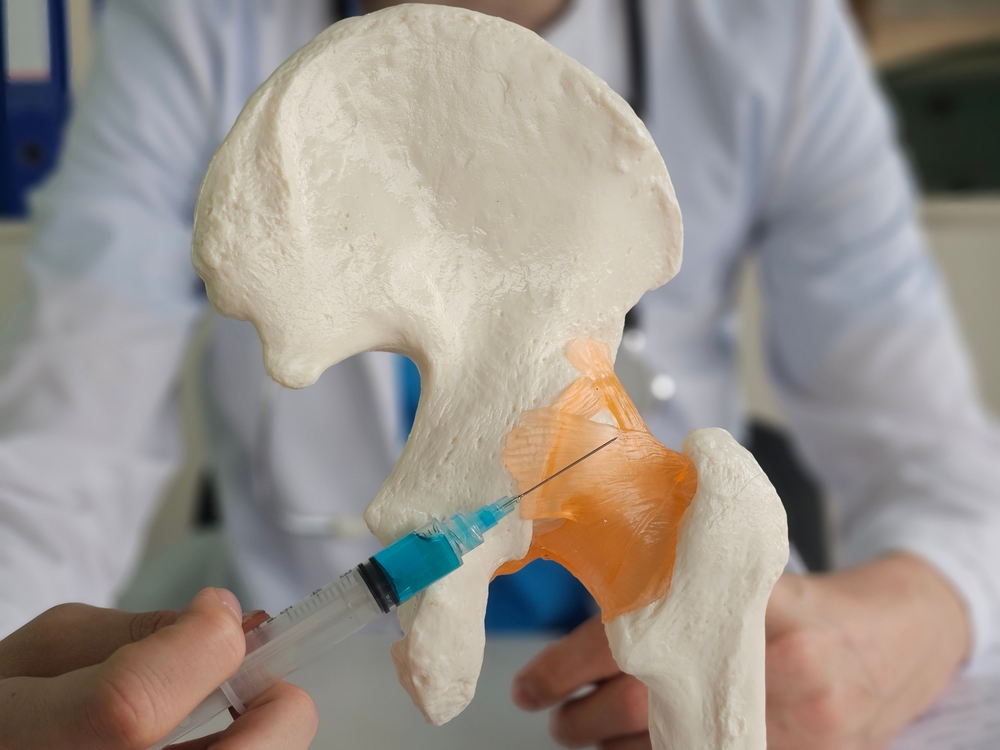
The hip is a ball-and-socket joint. The ball at the top of the thigh bone and the socket in the pelvis are both lined with smooth cartilage. In osteoarthritis, according to the American Academy of Orthopaedic Surgeons (AAOS), that cartilage gradually wears away, the space between the bones narrows, bone can end up rubbing on bone, and bony spurs may form.
The National Institutes of Health describes osteoarthritis as a disease in which the tissues of the joint break down over time, and notes that it is not simple wear and tear. Changes in the joint tissue trigger the breakdown, usually gradually. No current treatment reverses it, which is why care focuses on pain, movement and timing.
Risk goes up with age, a family history of osteoarthritis, a previous hip injury, obesity, and a hip socket that formed abnormally in childhood. AAOS notes that it occurs most often in people 50 and older, and that it can develop with none of these risk factors.
Solid national counts for the hip alone are hard to find. In one long-running study of 3,068 adults aged 45 and older in Johnston County, North Carolina, nearly 10% had hip arthritis that showed on X-ray and caused symptoms. In that same community, researchers estimated that about one in four people would develop symptomatic hip arthritis by age 85. Those are figures from one county, not the whole country.
How hip arthritis feels
Many people are surprised that hip arthritis is usually felt in the groin, not on the side of the hip. AAOS lists the typical pattern:
- Pain in the groin or thigh that can spread to the buttocks or the knee.
- Pain and stiffness that are worse in the morning or after sitting or resting.
- Stiffness that makes it hard to walk or bend, such as when tying a shoe or getting up from a chair.
- A locking, sticking or grinding feeling in the joint.
- Less range of motion and, over time, a limp.
- In later stages, pain at rest or at night.
Pain on the outside of the hip, or in the buttock with pain shooting down the leg, often has a different source. Our guide to hip pain causes explains how doctors tell these apart.
How it is diagnosed
Diagnosis rests on your history, a hands-on exam and X-rays. MRI or CT is needed only occasionally.
On exam, the doctor watches you walk and moves the hip through its range. A 2019 review in JAMA pooled six studies (1,110 patients) to see which exam findings best predict arthritis on X-ray. Among the most telling were groin pain when the leg is moved out to the side or across the body, weak hip muscles on the outer side, and reduced inward rotation of the hip. That same review found that among people seeing a primary care doctor for hip or groin pain, X-rays showed arthritis in the painful hip in 34%. Hip pain has many causes, so the exam matters.
On X-ray, the signs are narrowing of the joint space, bone spurs and other bone changes. Many reports grade severity from 0 to 4 on the Kellgren-Lawrence scale. Grade 2 means definite bone spurs, which researchers generally treat as the threshold for arthritis, and grades 3 and 4 mean moderate to severe changes with clear loss of joint space. The grade describes the picture. It does not always match how much pain you have.
Questions about your treatment options? Dr. Fox can help.
Book a ConsultationThis article is part of our Embolization Guide.
What the guidelines recommend
Two major U.S. guidelines cover hip arthritis: the American College of Rheumatology (ACR) osteoarthritis guideline, updated in 2026, and the AAOS hip osteoarthritis guideline, adopted in December 2023. They agree on most points.
| Treatment | ACR 2026 | AAOS 2023 |
|---|---|---|
| Exercise and physical therapy | Strongly recommends exercise | Physical therapy could be considered for mild to moderate arthritis |
| Weight loss if overweight or obese | Strongly recommends | No recommendation made on weight loss as a treatment |
| Anti-inflammatory pills (NSAIDs) | Strongly recommends | Should be used when not contraindicated |
| Steroid injection into the hip | Strongly recommends, with ultrasound guidance | Could be considered for short-term relief |
| Acetaminophen | Conditionally recommends | May be considered |
| Hyaluronic acid (gel) injection | Conditionally recommends against | Should not be considered |
| Opioid pain medicine | Conditionally recommends against | Workgroup opinion: should not be used |
| PRP and stem cell injections | Strongly recommends against | Not addressed |
A few notes help in reading that table.
Exercise. AAOS rated physical therapy as a moderate recommendation because the studies were split: of 15 studies, 7 found significant improvement over a control group and 8 found no significant difference. None found that it made people worse. ACR also conditionally recommends tai chi and heat or cold, and supports canes and other walking aids.
Weight loss. This is recommended by the ACR guideline for people who are overweight or obese. We present it as a guideline recommendation; we did not review trial data on weight loss for hip symptoms specifically.
Steroid injections. In the placebo-controlled trials AAOS reviewed, pain was better than placebo for up to eight weeks, and in one trial at two and four months. AAOS names two risks: infection, and a rapidly progressive form of hip arthritis after injection.
What to skip. AAOS found that gel injections do not improve pain or function better than placebo in the hip. Its workgroup advised against opioids based on knee studies showing more side effects without better pain or function. ACR also strongly recommends against glucosamine and chondroitin, and conditionally recommends duloxetine as another medicine option.
If you are still working through these steps, see hip pain treatment without surgery.
What hip replacement offers
Hip replacement is the established treatment for advanced hip arthritis, and it deserves a fair hearing. AAOS calls it one of the most successful operations in all of medicine. It reports that more than 450,000 are performed each year in the United States, and that the operation usually takes one to two hours.
According to AAOS, most people have a dramatic reduction in hip pain and a significant improvement in everyday activities, and most normal light activities can be resumed within three to six weeks. The complication rate is low, with serious complications such as joint infection in fewer than 2% of patients. Other possible complications include bleeding, blood clots, dislocation, a difference in leg length, and blood vessel injury.
Implants do wear. A 2019 analysis in The Lancet estimated from national registry data that about 58% of hip replacements last 25 years. High-impact activities such as running and jumping are generally discouraged afterward.
How the timing of hip replacement is decided
There is no X-ray grade or birthday that triggers surgery. AAOS says recommendations for surgery are based on a patient's pain and disability, not age, and that there are no absolute age or weight limits. Most people who have the operation are between 50 and 80.
In practice, replacement comes up when arthritis pain causes disability and is not relieved by non-surgical treatment. AAOS also identifies factors linked with worse results after hip replacement, based on limited evidence: a high body mass index, poorly controlled diabetes and tobacco use. A surgeon may ask you to work on those first.
That leaves a gap. Some people have pain that outlasts conservative care but are not ready for surgery, and some have medical conditions that make surgery too risky.
Where hip embolization fits
Hip embolization is a catheter-based procedure that reduces blood flow in small abnormal vessels around the painful joint. It has been studied mainly in people in that gap. Our hip embolization page describes the procedure, and the embolization guide covers other joints.
You should know how early this is. The hip is the least studied site for joint embolization. We found eight clinical publications on it through October 2026, mostly small single-center series, with follow-up of mostly 3 to 12 months. No randomized trial and no sham-controlled trial has been published. A 2026 expert review classed the hip evidence as hypothesis-generating. Neither the ACR nor the AAOS guideline mentions embolization.
- The largest hip-only study (HipE, Portugal, 2026) was a prospective series with no comparison group. Of 49 patients treated for hip arthritis or outer-hip tendon pain, 37 completed 12 months (31 with arthritis). Their average pain score went from 7.84 before treatment to 3.97 out of 10 at 12 months.
- A 2026 retrospective study from Berlin of 41 patients reported median pain going from 7 to 4 out of 10 at 12 months, with 12-month data for 28 of them. Two patients went on to hip replacement. The authors noted that without a control group they could not separate a true effect from a placebo response.
- A 2026 non-randomized study compared 26 embolization patients, all judged too high-risk for surgery, with 36 who had structured conservative care. At six months, the difference in pain between the groups was smaller than the amount the researchers had defined in advance as meaningful.
Reported side effects have mostly been minor, such as bruising at the puncture site. In one 13-patient study, two people had temporary numbness in the back of the thigh that resolved within 30 days. Studies have excluded people with hip infection, inflammatory arthritis, loss of blood supply to the ball of the hip, prior hip surgery, or a contrast dye allergy. These are study exclusion criteria.
So we make no promises about results. Embolization is not a replacement for hip replacement in advanced arthritis, and nobody knows whether it changes when surgery is eventually needed. It may be worth a conversation if conservative care has not been enough and surgery is not right for you now. See hip embolization vs. hip replacement and injections and what the hip embolization studies show.
Insurers that have written policies on joint embolization, so far for the knee, classify it as investigational or not medically necessary, and we found no hip-specific policy. Our Manhattan office verifies your benefits before treatment.
When hip pain needs urgent care
Arthritis pain builds slowly. Get emergency care for severe hip pain after a fall or injury, if you cannot walk or put weight on the leg, or if you have tingling or loss of feeling after an injury. Seek same-day care for sudden severe hip pain without a fall, or a hot, swollen hip, especially with a high temperature or feeling unwell.
Frequently Asked Questions
Where is hip arthritis pain usually felt?
Most often in the groin or thigh, sometimes spreading to the buttocks or knee. Stiffness after sitting or first thing in the morning is typical.
Do I need an MRI to diagnose hip arthritis?
Usually not. Diagnosis is based on your history, a physical exam and X-rays. According to AAOS, MRI or CT is needed only occasionally.
Do gel or PRP injections help hip arthritis?
Guidelines advise against them. AAOS found hyaluronic acid gel injections work no better than placebo in the hip, and the American College of Rheumatology strongly recommends against PRP and stem cell injections for hip osteoarthritis.
Am I too young or too old for a hip replacement?
AAOS says the decision is based on pain and disability, not age, and that there are no absolute age or weight restrictions. Most people who have the surgery are between 50 and 80.
Can hip embolization replace hip replacement?
No. Hip replacement is the established treatment for advanced arthritis. Hip embolization has only been tested in small studies without a placebo comparison, mostly in people who were not ready for or could not have surgery.
Keep Reading
- Hip Embolization in Manhattan
- Hip Embolization: Am I a Candidate?
- Hip Embolization Recovery Timeline
- Hip Embolization Research: What the Studies Show
- Hip Embolization Risks and Side Effects: What Studies Report
- Hip Embolization vs. Hip Replacement and Injections: An Honest Comparison
- Embolization Guide: knee, heel, shoulder, elbow and hip
Sources
- American Academy of Orthopaedic Surgeons, OrthoInfo: Osteoarthritis of the Hip
- National Institute of Arthritis and Musculoskeletal and Skin Diseases (NIH): Osteoarthritis
- Jordan et al., Journal of Rheumatology, 2009: Prevalence of hip symptoms and hip osteoarthritis, Johnston County Osteoarthritis Project
- Murphy et al., Osteoarthritis and Cartilage, 2010: Lifetime risk of symptomatic hip osteoarthritis
- Metcalfe et al., JAMA, 2019: Does this patient have hip osteoarthritis? Rational Clinical Examination systematic review
- Kohn et al., Clinical Orthopaedics and Related Research, 2016: Kellgren-Lawrence classification of osteoarthritis
- American College of Rheumatology, 2026: Update of recommendations for management of osteoarthritis of the knee, hip, and hand (summary)
- American Academy of Orthopaedic Surgeons, 2023: Management of Osteoarthritis of the Hip, clinical practice guideline
- American Academy of Orthopaedic Surgeons, OrthoInfo: Total Hip Replacement
- Evans et al., The Lancet, 2019: How long does a hip replacement last? Systematic review and meta-analysis
- Cavalheiro, Marinho Lopes et al., CardioVascular and Interventional Radiology, 2026: HipE study, hip embolization with 12-month follow-up
- Fleckenstein et al., CardioVascular and Interventional Radiology, 2026: Transarterial embolization for symptomatic hip osteoarthritis (41 patients)
- Feier, Bloj et al., Journal of Clinical Medicine, 2026: Periarticular embolization vs conservative care in surgery-ineligible hip osteoarthritis
- Correa et al., CardioVascular and Interventional Radiology, 2022: 6-month follow-up of hip embolization (13 patients)
- Pelage et al., CVIR Endovascular, 2026: Indication-stratified review of musculoskeletal embolization
- Aetna Clinical Policy Bulletin 0856: Embolization, Selected Procedures
- Cigna (eviCore) Peripheral Vascular Intervention Guidelines V2.0.2024
- Carelon Medical Benefits Management: Vascular Embolization and Occlusion Procedures guideline (effective 11/15/2026)
- NHS: Hip pain, when to get help
Medically reviewed by David Fox, MD, FACS, RPVI. This article is general information, not a substitute for a medical evaluation.
Living with joint or tendon pain that hasn’t improved? Schedule a consultation with Dr. David Fox at Fox Vein & Vascular in Manhattan to find out whether embolization is right for you. Call (212) 362-3470 or request an appointment online.