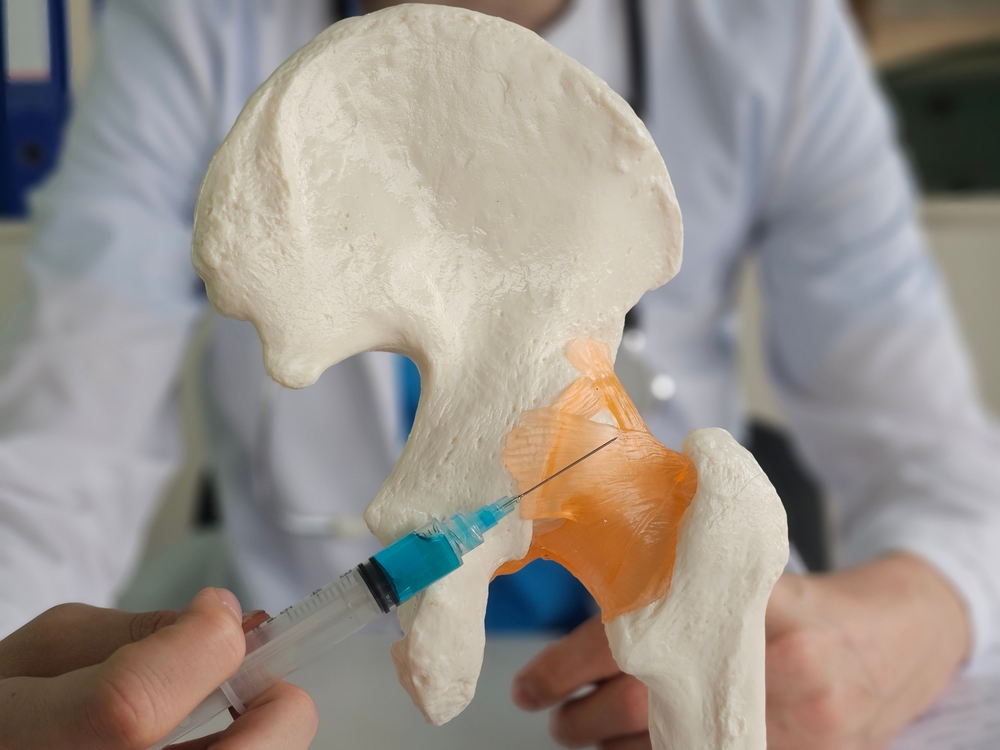
Hip embolization is a newer, image-guided procedure that aims to calm painful, inflamed tissue around the hip by reducing abnormal blood flow to it. It is offered to a fairly narrow group of people, and the research behind it is still early. This guide walks through who has been treated in published studies, who is usually not a good fit, and when another option, including hip replacement, is likely to serve you better. For an overview of the procedure itself, start with our hip embolization page.
The short version
In the studies published so far, people who had hip embolization generally shared a few traits:
- Hip pain that had lasted at least three months, and often more than a year.
- Pain that had not improved enough with standard care such as exercise, physical therapy, anti-inflammatory medicine or injections.
- A diagnosis confirmed by exam and imaging, usually mild to moderate hip osteoarthritis or greater trochanteric pain syndrome (pain on the outside of the hip from irritated gluteal tendons and bursa).
- A reason not to have hip replacement yet: they were not good surgical candidates, did not have advanced enough arthritis, or wanted to wait.
If that sounds like you, embolization may be worth discussing. It is not a first-line treatment, and it is not a substitute for a careful diagnosis.
Who was included in the hip studies
Because hip embolization is still being studied, the clearest guide to candidacy is who researchers chose to treat. The criteria varied from study to study:
| Study | Who was treated |
|---|---|
| 2026 Berlin study, 41 patients | Hip osteoarthritis confirmed on exam and X-ray, at least 3 months of pain despite conservative treatment |
| 2026 HipE study, 49 patients | Mild to severe hip osteoarthritis and/or greater trochanteric pain syndrome |
| 2025 pilot study, 18 patients | Older adults with early to moderate hip arthritis, symptoms for over a year, and at least one reason they could not have surgery |
| 2026 comparison study, 26 treated patients | Age 60 or older, moderate arthritis, significant pain, and judged too high-risk for hip replacement |
| 2022 and 2025 Brazilian studies | Mostly greater trochanteric pain syndrome that had not responded to conservative care or physical therapy, with no indication for surgery |
Two patterns stand out. First, almost everyone had already tried the standard steps. Second, many were older adults for whom surgery carried higher risk. That does not mean younger or healthier people cannot be considered, but there is less information about how they do.
Signs embolization may be worth discussing
You may be a reasonable person to evaluate if most of the following are true:
- Your pain is clearly coming from the hip. Groin pain often points to the joint itself, while pain on the outside of the hip often points to the tendons and bursa. Our guide to causes of hip pain explains the difference.
- You have given standard care a fair try. That usually means a structured exercise or physical therapy program, plus medicines and, for many people, an injection.
- Imaging matches your symptoms. X-rays show arthritis that is not yet end-stage, or an MRI or ultrasound shows tendon and bursa changes on the outside of the hip.
- Surgery is not the right next step for you right now. Your arthritis may not be advanced enough, your health may make surgery riskier, or you may want to delay it while understanding the trade-offs.
- You are comfortable with uncertainty. The results so far are encouraging but come from small studies without a placebo comparison.
Questions about your treatment options? Dr. Fox can help.
Book a ConsultationThis article is part of our Embolization Guide.
Who is usually not a good candidate
The published studies excluded several groups, which is a useful guide to who should look elsewhere. Depending on the study, these included people with:
- An active infection in or around the hip.
- Inflammatory arthritis, such as rheumatoid arthritis.
- Avascular necrosis (loss of blood supply to the ball of the hip joint).
- A previous hip or pelvic fracture, or previous hip surgery, including hip replacement.
- Cancer affecting the area.
- Peripheral artery disease or a bleeding or clotting disorder.
- A known allergy to the contrast dye used during the procedure.
- An injection into the hip joint within the previous three months.
Pain that actually comes from the lower back is another important reason to pause. Nerve pain from the spine can be felt in the buttock and hip, and embolization of hip blood vessels would not be expected to help it. Kidney problems and pregnancy also need careful discussion because the procedure uses X-ray imaging and contrast dye.
There is also no published research on embolization for pain that continues after a hip replacement. If that is your situation, it is an open question, not a proven use.
When hip replacement is likely the better path
Hip replacement is a well-established operation with long track records. A large 2019 analysis in The Lancet estimated that about 58% of hip replacements still last 25 years, based on national registry data. If your X-rays show severe, bone-on-bone arthritis, your hip shape has changed, or you cannot walk far despite everything you have tried, a consultation with an orthopedic surgeon is usually the right next step. In the 2026 Berlin study, two of 41 patients went on to hip replacement within the follow-up period.
Embolization is best thought of as a possible option for a gap: people whose pain is not controlled by conservative care but who are not ready for, or not able to have, surgery. You can compare the options side by side in hip embolization vs. hip replacement and injections.
What an evaluation usually involves
A candidacy visit is mostly about confirming where the pain comes from. It typically includes:
- A history of your pain: where it is, how long it has lasted, what makes it worse, and what you have already tried.
- A physical exam of the hip, back and circulation in your legs.
- A review of imaging. Standing X-rays of the pelvis and hip are the usual first test for chronic hip pain. Some patients also need an MRI or ultrasound, especially for pain on the outside of the hip.
- A review of your medicines, kidney function, allergies and bleeding risk.
Sometimes the right answer after this visit is a referral back to physical therapy, to a spine specialist, or to an orthopedic surgeon. That is a normal and useful outcome.
When to get help urgently
Do not wait for an embolization consultation if you have severe hip pain after a fall, cannot put weight on your leg, have numbness or tingling after an injury, or have a hot, swollen hip, especially with fever or feeling unwell. These can be signs of a fracture or joint infection and need same-day medical care.
Questions to bring to your consultation
- What do you think is causing my hip pain, and how sure are you?
- Have I tried enough conservative care, or is there something I have not tried?
- How severe is the arthritis on my X-rays, and would a surgeon consider me for replacement?
- What results are realistic for someone like me, given how small the hip studies are?
- If embolization does not help, what is the plan?
For a broader look at how embolization is used in other joints, see our embolization guide.
Frequently Asked Questions
Do I have to try physical therapy before hip embolization?
Nearly every published hip embolization study treated people whose pain had not improved with conservative care, which usually includes exercise or physical therapy. Guidelines for hip osteoarthritis strongly recommend exercise, so it is normally tried first.
Can I have hip embolization if my arthritis is severe?
Some studies included severe arthritis, but most focused on mild to moderate disease. If your hip is bone-on-bone, hip replacement is usually the better-established option, and a surgical opinion is worth getting.
Is hip embolization an option after a hip replacement?
No published studies have looked at embolization for pain after hip replacement, and the existing studies excluded people with prior hip surgery. It would be considered unproven in that situation.
Can embolization help pain on the outside of my hip?
Several small studies treated greater trochanteric pain syndrome, the most common cause of outer hip pain, with encouraging early results. The evidence is limited, and exercise-based physical therapy remains the first-line treatment.
Keep Reading
- Hip Embolization in Manhattan
- Hip Embolization Recovery Timeline
- Hip Embolization Research: What the Studies Show
- Hip Embolization Risks and Side Effects: What Studies Report
- Hip Embolization vs. Hip Replacement and Injections: An Honest Comparison
- What Is Causing Your Hip Pain? Arthritis, Bursitis and Tendinopathy Explained
- Embolization Guide: knee, heel, shoulder, elbow and hip
Sources
- Fleckenstein et al., Cardiovasc Intervent Radiol, 2026 — Transarterial embolization for symptomatic hip osteoarthritis (41 patients)
- Cavalheiro, Marinho Lopes et al., Cardiovasc Intervent Radiol, 2026 — HipE study: hip embolization for hip OA and GTPS, 12-month follow-up
- Feier et al., Cureus, 2025 — Periarticular embolization via brachial access in older adults with hip OA: pilot study (18 patients)
- Feier, Bloj et al., J Clin Med, 2026 — Periarticular embolization vs conservative care in surgery-ineligible hip OA (prospective comparative study)
- Correa et al., Cardiovasc Intervent Radiol, 2022 — 6-month follow-up of lateral femoral circumflex artery embolization for hip OA and GTPS (13 patients)
- Giordani et al., Cardiovasc Intervent Radiol, 2025 — Latino-Hip registry: midterm follow-up of embolization for GTPS (31 patients)
- Evans et al., Lancet, 2019 — How long does a hip replacement last? Systematic review and meta-analysis
- Chamberlain, American Family Physician, 2021 — Hip pain in adults: evaluation and differential diagnosis
- NHS — Hip pain: when to get help and common causes
- American College of Rheumatology, 2026 — Update of recommendations for management of osteoarthritis of the knee, hip, and hand (summary)
Medically reviewed by David Fox, MD, FACS, RPVI. This article is general information, not a substitute for a medical evaluation.
Living with joint or tendon pain that hasn’t improved? Schedule a consultation with Dr. David Fox at Fox Vein & Vascular in Manhattan to find out whether embolization is right for you. Call (212) 362-3470 or request an appointment online.