
Why Plantar Fasciitis Becomes Chronic: The Science Behind Persistent Heel Pain
You’ve done everything right. Stretching every morning, wearing custom orthotics, going to physical therapy, getting cortisone injections — maybe even trying shockwave therapy. And yet the heel pain persists, month after month, limiting the way you move through your day. If that sounds familiar, you’re not alone. Millions of people experience chronic plantar fasciitis, and for many of them, the question isn’t whether they’ve tried hard enough. The question is whether the treatments they’ve been using can actually reach the root of the problem.
The truth is, when plantar fasciitis becomes chronic, something fundamental changes inside the tissue itself. Understanding that change is the first step toward finding a treatment that can finally make a difference. At Fox Vein & Vascular, David Fox, MD, FACS, RPVI — a board-certified vascular surgeon with more than 28 years of experience — helps patients understand the science behind their persistent pain and offers advanced, targeted solutions when conservative care isn’t enough.

- Minimally invasive treatments
- Board-certified vascular surgeon
- No hospital stay
- Fast recovery
- Personalized care
Patient Testimonials
Acute vs. Chronic Plantar Fasciitis
Not all heel pain is the same. Acute plantar fasciitis is an inflammatory condition — the plantar fascia, the thick band of tissue connecting your heel to your toes, becomes irritated, swollen, and painful. In most cases, this initial inflammation responds well to conservative treatment within six to twelve months. Rest, stretching, orthotics, physical therapy, and anti-inflammatory medications can reduce the swelling and allow the tissue to heal.
Chronic plantar fasciitis is different. When heel pain persists beyond six to twelve months despite treatment, the tissue itself has changed. The condition is no longer driven primarily by inflammation — it has shifted toward degeneration. The plantar fascia develops microscopic tears, thickens abnormally, and loses its normal structural integrity. Some specialists use the term plantar fasciosis to describe this degenerative state, distinguishing it from the acute inflammatory phase.
This distinction matters because it helps explain a frustrating reality: treatments designed to fight inflammation may have limited effectiveness once the condition has become chronic. The underlying tissue changes require a different approach — one that addresses what’s actually sustaining the pain.

The Role of Neovascularity in Chronic Heel Pain
One of the most important discoveries in understanding chronic plantar fasciitis is the role of neovascularity — the growth of new, abnormal blood vessels into damaged tissue. In healthy tissue, blood vessel growth is a normal part of healing. But in chronic plantar fasciitis, the body overreacts. It creates a dense network of tiny, disorganized blood vessels that invade the damaged plantar fascia.
Here’s what makes this so significant: these abnormal blood vessels don’t arrive alone. They’re accompanied by small nerve fibers that grow alongside them. It’s this combination — abnormal vessels and new nerve fibers — that creates the persistent, often intense pain that defines chronic plantar fasciitis. The nerves transmit pain signals even in the absence of new injury, which is why the pain can feel constant and unrelenting.
This neovascularity sustains a self-perpetuating cycle:
- Tissue damagein the plantar fascia triggers a healing response
- The body grows abnormal blood vesselsinto the damaged area
- Nerve fibersgrow alongside those vessels
- Those nerves generate persistent pain signals
- Pain and altered movement patterns cause further tissue stress
- The cycle continues, even when the original inflammation has subsided
This is a critical concept because it explains why anti-inflammatory treatments — from ibuprofen to cortisone injections — eventually stop working. By the time plantar fasciitis has become chronic, the problem is no longer primarily inflammatory. It’s vascular and structural.
Why Traditional Treatments Hit a Ceiling
If you’ve tried multiple treatments without lasting relief, it’s not because those treatments failed entirely — it’s because they were designed to address a different stage of the condition. Each has real benefits, but also real limitations when it comes to chronic plantar fasciitis.
Cortisone Injections
Cortisone injections are powerful anti-inflammatory agents. They can provide temporary relief by reducing swelling and calming irritated tissue. However, they don’t address neovascularity. With repeated injections, their effectiveness tends to decrease. There’s also a risk of weakening or even rupturing the plantar fascia over time, which is why most physicians limit the number of injections.
Physical Therapy and Stretching
Physical therapy strengthens the muscles of the foot and lower leg, improves flexibility, and can reduce strain on the plantar fascia. These are important benefits, and PT remains a cornerstone of early plantar fasciitis treatment. But physical therapy cannot reverse the vascular changes that have taken hold in chronic cases. It can improve function and reduce stress on the tissue, but it can’t eliminate the abnormal blood vessels and nerve fibers that are sustaining the pain.
Orthotics
Custom orthotics and supportive footwear redistribute pressure across the foot, taking some of the mechanical load off the plantar fascia. They can reduce symptoms and slow progression — but like physical therapy, they address biomechanics rather than the underlying tissue changes driving chronic pain.
Shockwave Therapy
Extracorporeal shockwave therapy uses sound waves to stimulate a healing response in damaged tissue. Some patients experience relief, but results for chronic plantar fasciitis are inconsistent. The therapy may promote some degree of tissue repair, but it doesn’t specifically target the neovascularity that sustains chronic symptoms.
PRP Injections
PRP (platelet-rich plasma) injections use your own blood components to promote healing. The theory is sound — concentrate growth factors and deliver them directly to damaged tissue. However, the evidence for PRP in chronic plantar fasciitis is mixed. While PRP may support tissue repair, it doesn’t directly address the abnormal vascular networks that are the hallmark of chronicity.

Risk Factors for Developing Chronic Plantar Fasciitis
Certain factors can increase the likelihood that acute heel pain will progress to a chronic condition. Understanding these risk factors can help you and your healthcare provider anticipate challenges and adjust your treatment plan early:
- Prolonged standing occupations— jobs that keep you on your feet for hours place continuous stress on the plantar fascia
- Higher body weight— increased load on the feet accelerates tissue stress and slows healing
- Tight calf muscles— calf tightness increases tension on the Achilles tendon and plantar fascia with every step
- Sudden changes in activity level— ramping up exercise too quickly can overwhelm the tissue’s ability to adapt
- Foot mechanics— both flat feet and high arches can alter the way force is distributed through the plantar fascia
- Age— the plantar fascia naturally loses flexibility over time, making it more susceptible to microtears and degeneration
- Delayed treatment— waiting too long to address acute plantar fasciitis can allow the condition to progress to the chronic, degenerative phase
If several of these factors apply to you, it’s especially important to seek evaluation sooner rather than later — particularly if your symptoms have persisted beyond six months.

The Frustration of Chronic Heel Pain
Chronic heel pain isn’t “just heel pain.” It changes the way you live your life. It’s the sharp, stabbing sensation with your first steps every morning. It’s the dread of standing at work all day. It’s having to give up the exercise routine that kept you healthy, or even struggling through something as simple as walking the dog around the block.
The emotional toll is real. When pain limits your mobility, it affects your mood, your relationships, your independence, and your sense of well-being. Many patients with chronic plantar fasciitis describe feeling frustrated, discouraged, and even hopeless after months — sometimes years — of treatments that haven’t provided lasting relief. Those feelings are completely valid, and they deserve to be acknowledged.
If you’ve been told to “just keep stretching” or “give it more time,” and yet nothing has changed, it may be time to explore why the pain has become so persistent — and whether a different approach could help.
How Plantar Fasciitis Embolization Addresses Chronic Plantar Fasciitis
This is where the science of neovascularity becomes actionable. Plantar fasciitis embolization (PFE) is a minimally invasive, image-guided procedure that specifically targets the abnormal blood vessels sustaining chronic heel pain. Rather than masking inflammation or managing symptoms, PFE addresses a root cause that other treatments simply can’t reach.
During the procedure, Dr. Fox accesses the blood supply through a tiny puncture — typically at the ankle or top of the foot — and uses real-time fluoroscopic imaging to identify the abnormal microvascular networks feeding the damaged plantar fascia. Microscopic embolic particles are then delivered to block blood flow to these vessels. By reducing the blood supply to the areas of neovascularity, the chronic inflammatory cycle is interrupted at its source.
PFE uses the same proven embolization technology behind genicular artery embolization (GAE) for knee osteoarthritis — another condition where abnormal blood vessels and associated nerve fibers drive persistent pain. The procedure is performed under local anesthesia, takes approximately 45 to 90 minutes, and patients return home the same day. Most patients can return to light activity within 24 to 48 hours, with gradual pain improvement over two to six weeks and significant relief by two to three months.
This is why PFE may succeed where other treatments haven’t — it directly addresses the vascular changes that define the chronic stage of plantar fasciitis.
How Do You Know If Your Plantar Fasciitis Is Chronic?
Not every case of heel pain requires an advanced intervention. But if the following describe your experience, your plantar fasciitis may have entered the chronic phase:
- Your heel pain has lasted six months or longer
- You’ve tried multiple conservative treatments— orthotics, physical therapy, cortisone injections, shockwave therapy — without lasting relief
- Your pain pattern hasn’t changedsignificantly despite consistent treatment
- Imaging studiesmay show thickening of the plantar fascia and signs of neovascularity
- You’ve been told conservative treatments have failedbut you’re not ready for — or not a candidate for — surgery
If this describes you, a consultation with Dr. Fox can help determine whether PFE is an appropriate next step. During your visit, he’ll review your imaging, discuss your complete treatment history, and explain whether targeting the neovascularity in your plantar fascia could provide the relief you’ve been looking for.
Trained Alongside the Pioneer of Musculoskeletal Embolization
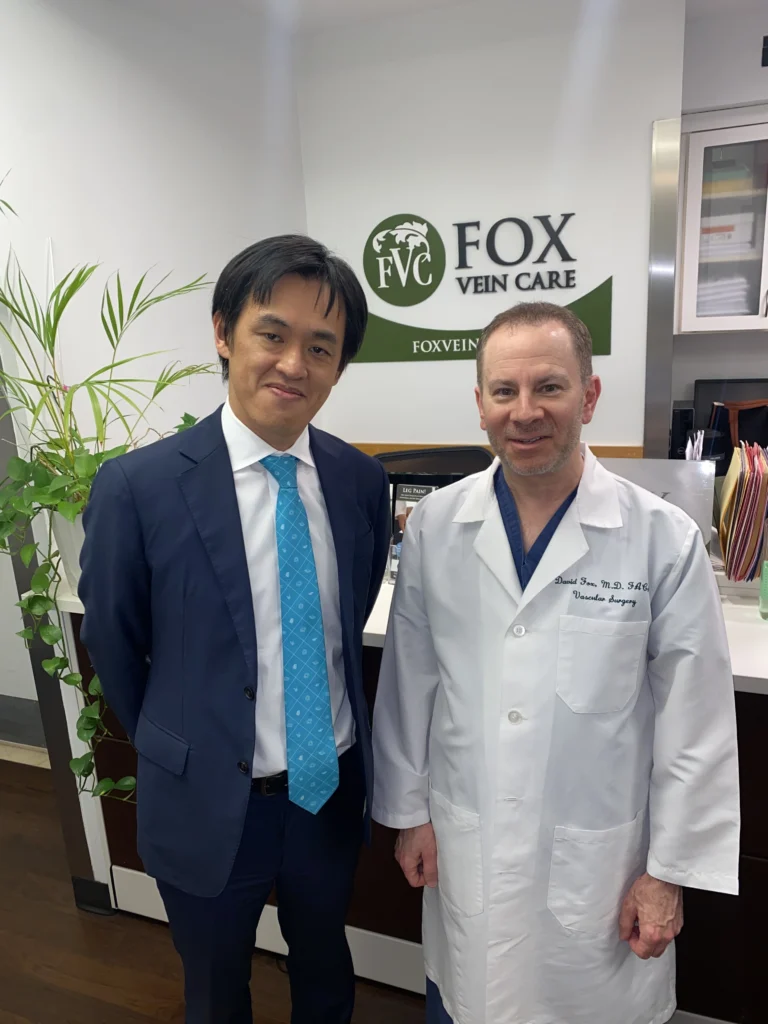
Dr. Fox recently hosted Dr. Yuji Okuno, MD, PhD — the Tokyo-based interventional radiologist who pioneered embolization for chronic joint and soft tissue pain — at his Manhattan practice following the 2026 GEST Global Embolization Symposium. Dr. Okuno’s published research on genicular artery embolization and plantar fasciitis embolization provides much of the clinical foundation behind the procedures performed at Fox Vein & Vascular.

David Fox, MD, FACS
- Double Board-Certified Vascular Surgeon
- Attending Vascular Surgeon, Lenox Hill Hospital
Dr. Fox has over two decades of experience diagnosing and treating venous and arterial conditions using the latest minimally invasive techniques. His approach is focused on precision, safety, and helping patients avoid major surgery whenever possible.
Real people. Real results.
Dr. Fox is an outstanding surgeon. Him and his staff explains everything clearly which makes for a smoother process. I've recommended him to family and several close friends, and they've all had the same excellent experience. If you want top-tier expertise with genuine compassion, Dr. Fox is the best. Highly recommend!
I had a very positive experience at Fox Vein Care. The doctor took time to explain everything clearly and made me feel comfortable throughout the process. The staff was also friendly and helpful. Overall, I felt well taken care of and am happy with my results. Highly recommended!
I had a great experience at this doctor's office. The doctor treated me with genuine care and respect, was very patient, and took the time to truly listen to my concerns. He explained everything clearly and gave thoughtful, helpful advice. I never felt rushed, and I left feeling confident and well taken care of. Highly recommend.
Dr. Fox is outstanding. He explains everything patiently and well. His staff is both efficient and kind. I wouldn't go anywhere else for vascular issues.
I have been a patient of Dr. Fox since he was at Roosevelt Hospital on 59th Street in Manhattan. He's the best, hands down! And his Staff are the best at what they do, along with excellent bedside manners. Crystal is the Greatest!
Wow What an incredible experience I have nothing short of a glowing review for this practice To begin I was Read More very nervous to have my initial consultation for varicose veins as this kind of stuff makes me pretty uneasy The staff made me feel at ease by explaining how many of these procedures Dr Fox preforms a week Him and his PA Stacey were able to explain the process and procedure in detail while also managing to calm my nerves Crystal who handled insurance approvals and scheduling the procedures was unbelievably accommodating with my tight schedule When I came in for both the EVLT and phlebectomy the staff was so kind and caring even one of the nurses-who always wore a flower in her shirt pocket-offered to hold my hand minutes before being taken into the operating room because she saw how nervous I was I was put to sleep for the - minute procedure so obviously didn't feel a thing I was greeted with a turkey sandwich when I awoke due to needing to fast before the procedure which I thought was a nice touch I felt little to no discomfort after the EVLT and mild to medium discomfort for about a week after phlebectomy Decent bruising for both but is now nearly gone weeks after Highly recommend Dr Fox and his team thank you for making what I thought would be a scary experience into an easy carefree one
I needed to have varicose vein work done on both of my legs during the summer and needed six procedures Read More to complete everything I had been putting it off for a few years but my experience at Fox Vein Care put me totally at ease From the very first consultation until the final procedure Dr Fox his entire staff were kind professional and took care of every step of the way The office was very well clean and well prepared in every way The insurance and financial concerns were handled easily and transparently The medical assistants were awesome and helpful with every process from the front desk to prepping to anesthesia and on into the operating room I am completely satisfied with the results and HIGHLY recommend Fox Vein care as a happy customer
Very good guy and knowledgeable. Very good at following up
Dr. Fox is the best at what he does. He and his staff are phenomenal.
Dr Fox great doctor! Beautiful staff! Clean environment! The best treatment ever...love Dr Fox!!!
I saw Dr Fox last week in his office and I must say I am very impressed and glad I Read More made this choice to see him and I was pleased with the results and treatment options The Whole staff is Amazing Crystal Ben Dr Fox Nicole And everyone else
Excellent patient education and care ESP the doctors surgical coordinator I believe her name is Crystal Attentive reassuring Honest Team Read More as well as Dr Fox was very knowledgeable and caring with my mom thank you so much
Dr Fox is excellent at explaining everything that needs to be done during vein procedures His experience and caring nature Read More shine through all interactions Crystal is also wonderful She is always helpful caring and efficient


Schedule Your Consultation
If you’re ready to explore whether plantar fasciitis embolization is right for you, contact Fox Vein & Vascular to schedule a consultation with Dr. Fox.
Call us: (212) 362-3470 Visit: Contact Us Location: Manhattan, New York
Dr. Fox and his team will review your imaging, discuss your treatment history, and help you understand whether PFE could be the right next step for your chronic heel pain.
Schedule a Consultation
We’re here to help you take the next step with confidence.