
Genicular Artery Embolization (GAE) in Manhattan
For many New Yorkers living with chronic knee pain—especially due to osteoarthritis—the traditional options have been limited: medications, injections, physical therapy, or eventually invasive knee replacement surgery. Genicular Artery Embolization (GAE) is an advanced, minimally invasive alternative designed to reduce inflammation, improve mobility, and significantly relieve pain without the risks of major surgery.
Learn more about who is a good candidate for GAE, what to expect from the GAE recovery timeline, and whether Medicare covers GAE.
At Fox Vein and Vascular, GAE is performed by David Fox, MD, FACS, RPVI a board-certified vascular surgeon with over 28+ years of experience performing image-guided, minimally invasive vascular procedures.

- Minimally invasive treatments
- Board-certified vascular surgeon
- No hospital stay
- Fast recovery
- Personalized care
Patient Testimonials
Real people. Real results.
Dr. Fox is an outstanding surgeon. Him and his staff explains everything clearly which makes for a smoother process. I've recommended him to family and several close friends, and they've all had the same excellent experience. If you want top-tier expertise with genuine compassion, Dr. Fox is the best. Highly recommend!
I had a very positive experience at Fox Vein Care. The doctor took time to explain everything clearly and made me feel comfortable throughout the process. The staff was also friendly and helpful. Overall, I felt well taken care of and am happy with my results. Highly recommended!
I had a great experience at this doctor's office. The doctor treated me with genuine care and respect, was very patient, and took the time to truly listen to my concerns. He explained everything clearly and gave thoughtful, helpful advice. I never felt rushed, and I left feeling confident and well taken care of. Highly recommend.
Dr. Fox is outstanding. He explains everything patiently and well. His staff is both efficient and kind. I wouldn't go anywhere else for vascular issues.
I have been a patient of Dr. Fox since he was at Roosevelt Hospital on 59th Street in Manhattan. He's the best, hands down! And his Staff are the best at what they do, along with excellent bedside manners. Crystal is the Greatest!
Wow What an incredible experience I have nothing short of a glowing review for this practice To begin I was Read More very nervous to have my initial consultation for varicose veins as this kind of stuff makes me pretty uneasy The staff made me feel at ease by explaining how many of these procedures Dr Fox preforms a week Him and his PA Stacey were able to explain the process and procedure in detail while also managing to calm my nerves Crystal who handled insurance approvals and scheduling the procedures was unbelievably accommodating with my tight schedule When I came in for both the EVLT and phlebectomy the staff was so kind and caring even one of the nurses-who always wore a flower in her shirt pocket-offered to hold my hand minutes before being taken into the operating room because she saw how nervous I was I was put to sleep for the - minute procedure so obviously didn't feel a thing I was greeted with a turkey sandwich when I awoke due to needing to fast before the procedure which I thought was a nice touch I felt little to no discomfort after the EVLT and mild to medium discomfort for about a week after phlebectomy Decent bruising for both but is now nearly gone weeks after Highly recommend Dr Fox and his team thank you for making what I thought would be a scary experience into an easy carefree one
I needed to have varicose vein work done on both of my legs during the summer and needed six procedures Read More to complete everything I had been putting it off for a few years but my experience at Fox Vein Care put me totally at ease From the very first consultation until the final procedure Dr Fox his entire staff were kind professional and took care of every step of the way The office was very well clean and well prepared in every way The insurance and financial concerns were handled easily and transparently The medical assistants were awesome and helpful with every process from the front desk to prepping to anesthesia and on into the operating room I am completely satisfied with the results and HIGHLY recommend Fox Vein care as a happy customer
Very good guy and knowledgeable. Very good at following up
Dr. Fox is the best at what he does. He and his staff are phenomenal.
Dr Fox great doctor! Beautiful staff! Clean environment! The best treatment ever...love Dr Fox!!!
I saw Dr Fox last week in his office and I must say I am very impressed and glad I Read More made this choice to see him and I was pleased with the results and treatment options The Whole staff is Amazing Crystal Ben Dr Fox Nicole And everyone else
Excellent patient education and care ESP the doctors surgical coordinator I believe her name is Crystal Attentive reassuring Honest Team Read More as well as Dr Fox was very knowledgeable and caring with my mom thank you so much
Dr Fox is excellent at explaining everything that needs to be done during vein procedures His experience and caring nature Read More shine through all interactions Crystal is also wonderful She is always helpful caring and efficient


What Is Genicular Artery Embolization (GAE)?
Genicular Artery Embolization (GAE) is a minimally invasive procedure used to reduce chronic knee pain caused by osteoarthritis. Instead of replacing the knee joint, GAE targets the abnormal blood vessels that develop around inflamed knee tissue and contribute to ongoing pain and swelling.
During the procedure, a small catheter is guided through the arterial system using advanced imaging technology. Tiny embolic particles are then delivered into specific genicular arteries surrounding the knee. These particles reduce excess blood flow feeding the inflamed synovial lining, which may decrease inflammation, stiffness, and pain over time.
GAE is performed without large incisions, joint replacement hardware, or removal of cartilage or bone. Most patients return home the same day and resume light activity within a few days.
- are not ready for knee replacement surgery
- have not responded well to physical therapy, injections, or medications
- want a non-surgical treatment option
- are trying to stay active while managing osteoarthritis symptoms
At Fox Vein & Vascular, Dr. David Fox performs GAE using real-time vascular imaging and minimally invasive catheter techniques developed through decades of vascular intervention experience.

How Does GAE Work?
Osteoarthritis does not only affect cartilage inside the knee joint. In many patients, the body also develops abnormal inflammatory blood vessels around the knee capsule and synovial tissue. These vessels contribute to chronic inflammation, swelling, and pain signaling.
GAE works by targeting these abnormal vessels directly.
Using live fluoroscopic imaging, Dr. Fox guides a microcatheter through the arterial system to the genicular arteries surrounding the knee. Once the inflamed vessels are identified, microscopic embolization particles are carefully injected to reduce excess blood flow to the affected tissue.
The goal is not to block normal circulation to the knee. Instead, the procedure selectively decreases the abnormal inflammatory blood supply associated with osteoarthritis pain.
Step-by-Step Overview
1. Access
A small entry point is created, usually near the groin or ankle, to access the arterial system. No surgical incision or stitches are typically required.
2. Catheter Navigation
A thin catheter is advanced through the blood vessels using real-time X-ray imaging guidance.
3. Embolization
Tiny embolic particles are delivered into targeted genicular arteries associated with inflammation.
4. Completion
The catheter is removed and a small bandage is applied. Most procedures take approximately 45–90 minutes.
Most patients go home the same day.
Who Is a Good Candidate for GAE?
GAE is ideal for patients with knee osteoarthritis, especially if they:
- Experience persistent knee pain despite conservative treatments
- Are not ready or not suitable for knee replacement
- Want to avoid steroid injections or cannot receive them
- Prefer a minimally invasive treatment option
- Have failed physical therapy, NSAIDs, viscosupplementation (hyaluronic acid, gel injections, Synvisc, Orthovisc, etc), or PRP
- Have chronic pain that limits daily activities or physical therapy
GAE may NOT be ideal for patients with:
- Active joint infection
- Severe peripheral arterial disease
- End-stage bone-on-bone degeneration; a patient may benefit from imaging review (less likely to work, but we can try it)
A consultation with Dr. Fox—including diagnostic ultrasound and a review of imaging studies—is the best way to determine candidacy.

Why Patients Are Considering GAE Instead of Knee Replacement
Many patients researching Genicular Artery Embolization are trying to delay, avoid, or better prepare for knee replacement surgery. While knee replacement remains an important option for advanced osteoarthritis, not every patient is ready for a major orthopedic procedure.
GAE offers a non-surgical alternative that may help reduce pain and improve mobility without joint replacement, implanted hardware, or extended surgical recovery.
Patients commonly explore GAE when they:
- still want to stay active
- have persistent pain despite injections or therapy
- are not ideal surgical candidates
- want to postpone knee replacement
- are concerned about recovery time after orthopedic surgery
Unlike arthroscopic surgery or total knee replacement, GAE is performed through a tiny catheter using image-guided vascular techniques. Most patients return home the same day.
For some patients, GAE may provide meaningful symptom relief while helping preserve mobility and quality of life.

Clinical Research and Outcomes
Genicular Artery Embolization has been studied as a minimally invasive treatment option for knee osteoarthritis in patients with chronic pain that has not responded to conservative therapy.
- reductions in knee pain scores
- improved mobility and daily function
- lower inflammation within the treated knee
- sustained symptom improvement in many patients over 12–24 months
GAE continues to gain attention among interventional radiologists and vascular specialists as interest grows in non-surgical osteoarthritis treatment options.
While outcomes vary by patient and severity of arthritis, many individuals experience meaningful improvement without undergoing knee replacement surgery.
Advancing Embolization in Collaboration with Global Leaders
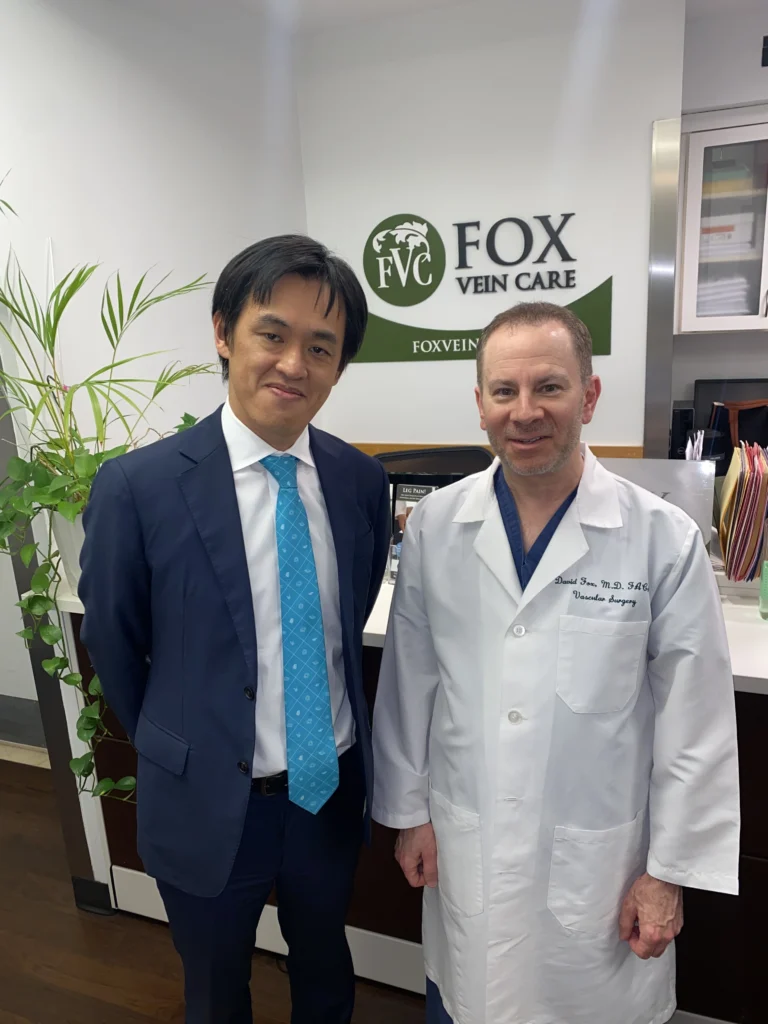
Fox Vein & Vascular is committed to staying at the forefront of minimally invasive pain treatment. In May 2026, Dr. David Fox had the privilege of hosting Dr. Yuji Okuno, MD, PhD — the internationally recognized pioneer of musculoskeletal embolization — at his Manhattan office following the GEST 2026 Global Embolization Symposium in New York City.
Dr. Okuno, founder of Okuno Clinic in Tokyo, developed the foundational techniques behind transcatheter arterial micro-embolization (TAME) for chronic pain conditions, including knee osteoarthritis and plantar fasciitis. His published research — spanning more than 60 plantar fasciitis embolization cases with up to four years of follow-up — helped establish the clinical evidence that supports the procedures Dr. Fox performs at Fox Vein & Vascular today.
The visit provided an opportunity for Dr. Fox and Dr. Okuno to exchange insights on technique refinements, patient selection, and the future of embolization-based treatments for musculoskeletal conditions. This type of direct collaboration with the physicians shaping the field reflects Dr. Fox’s dedication to offering Manhattan patients access to the most advanced, evidence-based treatment options available.
Benefits of Genicular Artery Embolization
Patients choose GAE because it offers:

Minimally invasive treatment—no incisions
Outpatient procedure with same-day discharge
Rapid recovery (often within days)
Significant reduction in pain and inflammation
Non-surgical alternative to joint replacement surgery
No metal implants or removal of tissue
Lower risk than orthopedic surgery
Sustained pain relief lasting 12–24+ months
GAE vs. Other Knee Pain Treatments
| Treatment | Invasiveness | Duration of Relief | Ideal For |
|---|---|---|---|
| GAE | Minimally invasive, catheter-based | Often long-term | OA patients who wish delay or avoid knee replacement surgery |
| Steroid injections | Minimally invasive | Weeks–months | Short-term relief |
| Hyaluronic acid injections | Minimally invasive | Variable | Mild–moderate OA |
| PRP/Stem cell therapy | Minimally invasive | Under study | Some early-stage cases |
| Arthroscopic surgery | Moderately invasive | Limited for OA | Mechanical tears, not OA |
| Total knee replacement | Major surgery | Long-term but major recovery | Severe OA only |
What to Expect During Your GAE Procedure

Before the Procedure
- Consultation and medical evaluation
- Review of imaging studies
- Instructions on medications and hydration
- Procedure is performed with local anesthesia + light sedation

During the Procedure
- You lie comfortably on a procedure table
- Local anesthetic is used at the access site
- Real-time imaging guides catheter placement
- Tiny particles are released with precision
- Most patients feel no significant discomfort

After the Procedure
- You rest briefly in recovery
- Discharged home the same day
- Mild soreness/bruising at the injection site
- Some patients experience a short-lived increase in knee pain
- Most patients resume normal activity in 24–48 hours
Recovery & Results
Timeline of improvement:
- 1–2 days: Return to daily activities
- 2–6 weeks: Noticeable reduction in pain
- 3–6 months: Maximum improvement
- 12–24+ months: Relief often sustained
Most patients can walk, work, and perform light exercise quickly after treatment.
Risks & Safety
GAE is considered safe with a low complication rate. Potential risks may include:
- Temporary skin discoloration
- Bruising at the puncture site
Rare adverse events:
- Transient numbness
- Non-target embolization (minimized through expert imaging)
- Allergic reaction to contrast dye
Dr. Fox’s extensive vascular training and experience helps ensure precise, safe treatment.
A consultation with Dr. Fox — including diagnostic ultrasound and a review of imaging studies — is the best way to determine candidacy.
Why Choose Dr. Fox for Vein
Problems in Manhattan?

Board-Certified Vascular Expertise
Dr. Fox is a board-certified. fellowship-trained vascular surgeon with extensive experience in vein treatment and imaging technology.
Advanced Imaging Technology
Comprehensive Vascular Evaluation
We assess venous and arterial health holistically to ensure optimal outcomes.
Minimally Invasive Philosophy
We specialize in procedures that reduce pain, downtime, and surgical risk.
Personalized Vein Treatment Plans
Every vein procedure is tailored to the individual’s pain pattern, imaging findings, and lifestyle needs.
Frequently Asked Questions
How Long Does The GAE Procedure Take?
Most cases take 45–90 minutes.
Is GAE Painful?
Patients feel little to no discomfort due to local anesthesia and light sedation.
How Soon Can I Walk After GAE?
Most patients are able to walk the same day after the procedure and return to light daily activities within 24–48 hours.
Will GAE Cure My Arthritis?
GAE reduces inflammation and pain but has not yet been demonstrated to alter the natural history of osteoarthritis or reverse cartilage loss. It has been proven in multiple clinical studies to improve quality of life and function.
Can I Still Get Knee Replacement Later?
Yes. GAE does not interfere with orthopedic surgery if needed in the future.

David Fox, MD, FACS
- Double Board-Certified Vascular Surgeon
- Attending Vascular Surgeon, Lenox Hill Hospital
Dr. Fox has over two decades of experience diagnosing and treating venous and arterial conditions using the latest minimally invasive techniques. His approach is focused on precision, safety, and helping patients avoid major surgery whenever possible.
You don’t have to live with pain, swelling, or limited mobility.
Get a personalized evaluation and find out which treatment is right for you.
Schedule a Consultation
We’re here to help you take the next step with confidence.